A Street with an Identity
Author: Cux | Category: Around the world, Arts & Crafts, Canada, Landmarks, Museums, Toronto, World's greatest | Tags: Bata Shoe Museum, Bellair Street, Bloor Street, Bloor Street East, Bloor Street West, Bloor-Yorkville, Cumberland Street, Joseph Bloor, ROM, Royal Ontario Museum, Yorkville Avenue
It was to Bloor-Yorkville, the so-called swanky neighborhood that I took my friend to show her the fashionable areas in Toronto. “Well, this looks pretty usual!” was her response; my friend didn’t seem very impressed.

I agreed with her as, unfortunately, that day, even the streets were crowded, with the TTC (Toronto Transit Commission) plying shuttle buses from Bloor further south to downtown Toronto. So, the extra load of subway people on the streets along with the construction work obstructing the roads (related to the condos and the sidewalks) added to the chaos.
The high-end shopping malls and the big branded stores located in Bloor-Yorkville makes it known as ‘the shopping district of Toronto.’ According to the Fortune Magazine, it is ‘the seventh most expensive shopping street in the world.’

Bloor Street spans 25 kms and is an important arterial road in Toronto, the other being Yonge Street. Beginning at Prince Edward Viaduct in the east of Toronto, the road extends till Mississauga in the west. I could not find the exact year when Bloor Street was built but it was in the nineteenth century that the street got its name from Joseph Bloor, an industrialist, who established the Village of Yorkville in 1830, courtesy Wikipedia.
Gradually, the region grew into a major residential and commercial hub. 2008 data reveal that the shops in Yorkville earn a rent of 300$ per square foot and the condos are priced from 1mn$ upwards.

A section of Yorkville Avenue enclosed by Cumberland Street and Bellair Street looks hip and resembles a European town, with cobblestoned roads lined with cafes, pubs, sushi bars, posh restaurants, salons, and designer boutiques. Facing the opposite side of the street is an artistic park strewn with stone and metal sculptures and branded shops. For a change, my friend was charmed by the elegant surroundings there.

Cumberland Street is that part of Bloor Street where people love to be seen drinking, eating, and shopping.
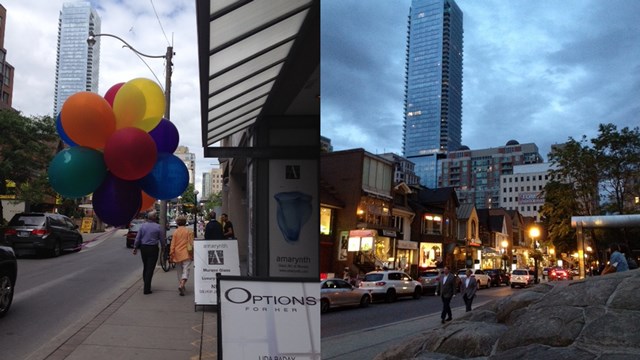
Hemingway’s is a popular pub there and Trattoria Nervosa serves awesome-tasting Italian food, moderately priced. Definitely worthy of multiple visits!

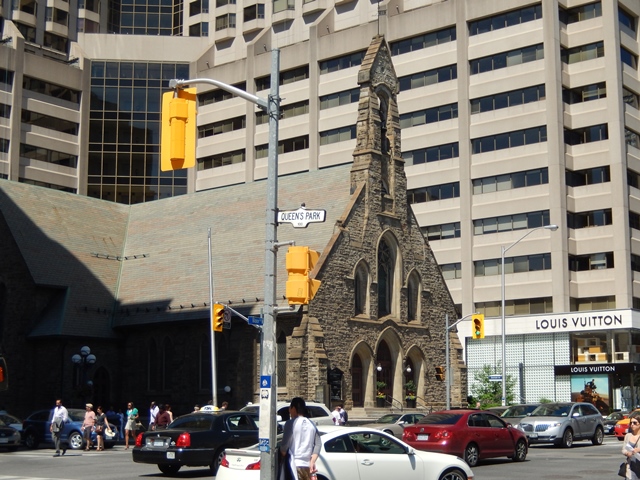
Bloor Street has a unique historical appeal as it houses many old buildings embodying European style architecture and design. The intersection of Yonge and Bloor divides Bloor into east and west zones. Yorkville is situated on the west side while the east side mostly has tall corporate buildings and is more recently developed. The Royal Ontario Museum (ROM) with the Michael Lee-Chin Crystal, world-renowned as an architectural splendor, and the Bata Shoe Museum are two significant places to visit.

The ROM is a wonderful treat for art lovers with five floors of beautiful art and sculpture from cultures around the world, depicted through the ages. The natural history sections are also very informative whilst no kid can ever forget the huge dinosaur exhibits that they were delighted to see and which still remain as their fond childhood memories.

I have made a custom of visiting the ROM once every six months. Or so it happens! With each visit, it seems like there is more and more to see and I come away regretfully with the feeling of not having spent adequate time.

My friend was more interested in the Bata Shoe Museum that showcased the evolution of footwear for different societies along with shoes worn by prominent celebrities. I loved the intricately designed and beaded moccasins of the Aboriginal peoples of Canada the best.

10 Jun 2014


