New York

The Cloisters Museum and Gardens

Every person in the city, whether a native New Yorker or a visitor, has heard of the Metropolitan Museum. And a majority would have been there too, at least once. But that is not the case with the Cloisters, located at the top of Manhattan. Though it is a branch of the Met, not many people are familiar with this unique museum.

CMG-building

The Cloisters Museum and Gardens is focused on the art and architecture of medieval Europe, mainly from 12th to 15th centuries.

CMG-ceiling2

In fact, the whole place is designed on the architectural principles of a cloister in medieval Europe, though not modelled on any particular one, instead borrowing features from many.

CMG-pillars

When you see the museum, you will realise the appropriateness of the name as cloisters were living spaces for the monks, attached to cathedrals and churches in medieval European history.

CMG-ceiling

The building with its stained glass windows and column capitals truly exudes an aura of grandeur and you feel like you are stepping into a long gone age of chanting monks leading a secluded life.

CMG-pillars2

Among the decorative and liturgical art collection from various parts of Europe on display are illuminated manuscripts, stained glass, metalwork, enamels, ivories, and tapestries.

CMG-art1

Most renowned among them are a series of seven tapestries, ‘The Hunt for the Unicorn’, commonly known as the Unicorn Tapestries.

CMG-unicorn

These tapestries tell the story of how the unicorn is captured and killed, yet alive again and happily living in captivity. Leaving aside the allegorical allusions aside, these tapestries are full of rich details. Over a hundred plants and flowers are shown in detail, each bearing a significance to the story. A trip to the Cloisters is worth just to look at this set of tapestries; they are so rich and wonderful.

CMG-flowers

The gardens at the Cloisters are unique in the sense that they are aligned with the culinary arts. There are all kinds of plants, fruit bearing trees and herbs used in the preparation and flavouring of food. Also, there are many medicinal plants as well. These are plants that played a prominent part in the daily lives of the people living then.

CMG-trees

For example, you will see woad, weld and madder plants that were used in the dyeing of material in blue, yellow and red respectively. And remember, these are the colours used to colour the threads in the tapestries that we just spoke about.
 
Intriguingly, there is a section of the garden devoted to poisonous plants! Of course, these plants too had medicinal qualities in the right hands, but the medieval background reminds one of many a story of intrigue and treason where poison played a main role.
 
These gardens have been planned and laid out to replicate a cloistered garden in the medieval times, based on horticultural information found in medieval treatises and poetry, and garden documents and herbals. A herbal, by the way, is a book containing descriptions of plants put together for medicinal purposes.
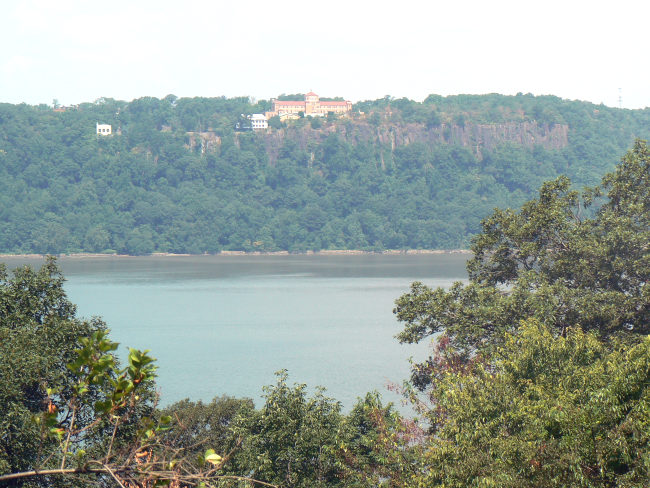
CMG-view

And the view… Did I mention that the Cloisters is located overlooking the Hudson? From the walks around the gardens, the view of the cliffs across the river is awesome!

CMG-geo-wash-bridge

Included in the view is the George Washington Bridge stretching across to New Jersey.

CMG-walks

Opened on May 14, 1938, the museum is celebrating its 75th anniversary this year. And what better occasion than this to make a visit to the Cloisters Museum and Gardens? And the summer is the ideal time to pack a picnic lunch and spend a glorious day at this museum.


~Ria

11 Jul 2014

On the Kindness of Strangers…

At some time or other, we have all been touched by the kindness of strangers. I’m not talking about someone helping you with a heavy suitcase down the staircase at the train station or holding the door for you when you are loaded with shopping bags. Those are actions of the moment, without much thought behind them, more like reflexes of good manners. What I’m referring to are actions that are the results of conscious decisions to help others with no thought of personal gain.
 
The other day I was listening to ‘This American Life’ on NPR, and the story was about unusual acts of kindness by strangers. What was unusual about them was that some of the stories were not even intended as acts of kindness. Like, the guy who walked along the subway platform, telling each waiting passenger that were either in or out. The story goes on to narrate how inspiring it was to be told ‘you’re in’, though it meant nothing and was just a random muttering from a stranger. Was there an intention here to help people feel good? I would rather doubt it, but the end result was that it made others happy.
 
Listening to the stories, I was reminded of an incident, two summers ago, when I was subject to an act of kindness – actually, more like a present – from a stranger.
 
It was around 2 pm and I was waiting for a train to downtown, to meet a friend for a movie. As usual I had a book with me, and sat reading as I was a few minutes early. Suddenly I got this feeling that eyes were upon me and looking up saw this person watching me intently. I looked around; lots of people on the platform, so no need to worry. Ignoring the watching eyes I returned my attention to the book.
 
Time for the train and I got up and walked out. The person approached me smiling and started speaking. It was easy to say, ‘sorry, I don’t speak Spanish’. He extended a small card towards me and kept talking in a mix of English and Spanish. The only words I could get were… ‘for you… books… to read’. He pushed the card into my hand. I looked down and saw that it was a Barnes & Noble gift card. Like a true New Yorker I thought… Oh, the guy wants to sell me the card – probably blank. Yeah, right!
 
By this time, the train was approaching the platform. I tried to give the card back to him. But he wouldn’t take it and kept explaining. What I could grasp from his talk was this: he was a visitor to the city and was going back that day. Did not have time to use the card, and so wanted to give it to me.
 
The train doors were open, and it was easier to say ‘thank you’ and get in to the train than continue arguing with him. And I was careful to sit far away from where he sat. I pushed the card into the book I was reading.
 
I did not think of it further till I was passing in front of the Barnes & Noble store on Broadway (which has since closed). Went in and checked to see if the card was of any value. How much do you think was on that card? 78 dollars! I was amazed, to say the least. And truly felt ashamed at being so suspicious of the guy’s intentions!
 
Why did he pick me to make a present of the card? I cannot make a guess, except maybe it was because I was the only one reading a serious book on the station platform.
 
I still remember two of the books I bought with that card… ‘Unaccustomed Earth’ by Jhumpa Lahiri and ‘Half Asleep in Frog Pajamas’ by Tom Robbins, both of which I thoroughly enjoyed!

20 Jun 2014

The Park in the Sky

How often does one get a chance to be part of history? That too, the history of such magnificent city as New York? Such was the good fortune of the people around when the Highline opened on June 9, 2009.

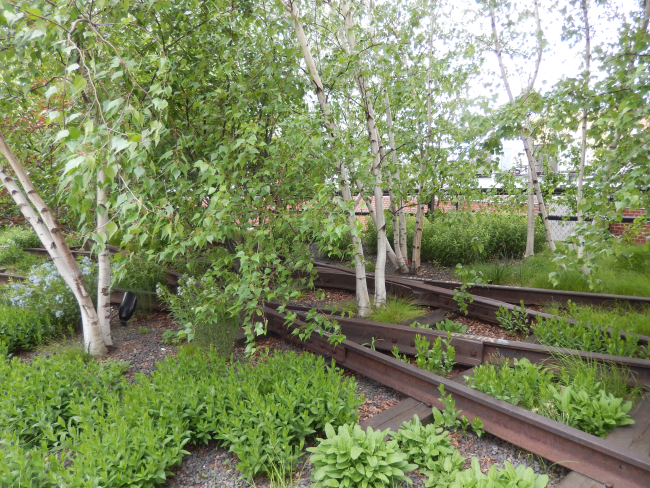
What is Highline? It is a beautiful, beautiful park that was built and nurtured on the abandoned old tracks of the 6th Avenue El!

hl-rails2

A bit of flashback… the Els, or elevated railroads, in New York were built to avoid the frequent accidents that used to happen with the freight trains running on the ground in the city. It was sooo bad that horse-riding men were employed to gallop ahead of running trains, waving red flags, to keep pedestrians off the tracks! Hence was conceived the idea of train tracks off the ground and running above the city streets.

On June 5, 1878, the 6th Ave El started operations. It covered a distance of 13 miles with stations at Rector St, Cortlandt St, and Park Place on Church Street; Chambers St, Franklin St, Grand St, Bleecker St on West Broadway; 8th, 14th, 23rd, 28th, 33rd, 42nd, 50th and 58th Streets on Sixth Avenue. The line also connected directly to factories and warehouses, enabling freight trains to deliver meat and produce – raw as well as processed – inside the buildings. And what is great, is that the traffic on the El did not affect the ground traffic at all!

However, by the 1930s, the decline of the El had started. The entire structure had weakened beyond hope of repairs. After being operational for 60 years, it was decided that the 6th Avenue El will be torn down. And on Dec 4, 1938, the operations on the line came to an end. And parts of the line were dismantled.

Fast forward to 1980s… plans are being made for the demolition of the remaining parts of the El. Local residents headed by environmentalists and activists challenge the plans in court. In 1999, a neighbourhood group, ‘Friends of the High line’ is formed to find alternate usage for the space offered by the now defunct railroad tracks.
Gradually support for the group increases and in 2002 a City Council resolution is passed advocating the reuse of the tracks.

In 2004, funding from the city is acquired for the development of the tracks. A design is selected through competition and the Highline Park comes into being, with the first section extending from Gansevoort Street to West 20th Street open to the public on June 9, 2009!

hl-rails1

‘Enchanting’ is an apt word to describe the Highline. The rail tracks are kept intact and flowers, shrubs and trees of all kinds are planted along the sides and between the tracks. And they change according to the seasons, adding variety to the overall sense of greenness that the park has.

hl-flowers

The rail tracks that used to go into the meat packing factories and other manufacturing facilities can still be seen, though the entrances to the buildings are blocked up.

hl-rails4

You can enjoy coffee, snacks and ice cream in one of these red brick factories, converted to a small marketplace. Also, you will find commemorative t-shirts, pens and very interesting books in the marketplace.

hl-rails3

And the Highline has become a venue for art shows and exhibitions. The other day when we visited, a sculpture show was going on, attracting quite a few fans.

hl-artwork

In fact, the whole area surrounding the Highline has developed an aura of artiness as evident from the street paintings and art objects.

hl-neighbouring-art1

Looks like even the neighbouring buildings are inspired to contribute to the effort!

hl-neighbouring-art2

And the views! Boy oh boy! It’s wonderful to look along the streets from the height of the Highline Park.

hl-view-left

And some of the best views of the Hudson are from the Highline.

hl-hudsonview2

Looking for an exotic venue for your next event or occasion? Come to the Highline! And if you are in a mood to help out with the park, you can always volunteer. All in all, the Highline Park is making history in the neighbourhood!


~Ria

06 Jun 2014

Broadway!

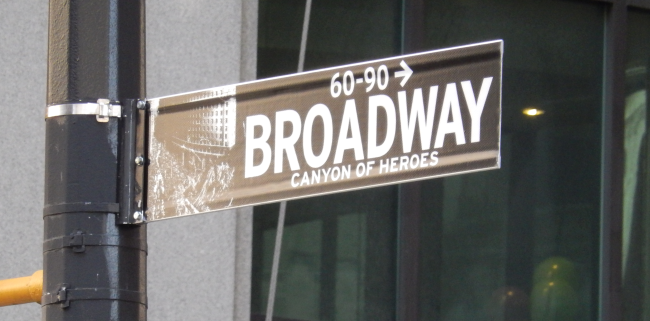
If anyone was asked to name the most heard of street – road, highway, boulevard, whatever – in the world, the universal answer will be ‘Broadway’! Reaching far back into history, and glorified in so many works of fiction and poetry, this thoroughfare could be the most identifiable single element of the great city of New York!
 
broadway

This is the oldest north-south arterial road in New York, existing from pre-Dutch times, when it was just a trail used by the native Americans. With the Dutch settling at the southern end of Manhattan island in 1620s, it became a country road extending north, beyond the gates of the settlement at present-day Wall Street. Today Broadway runs the length of Manhattan, starting at Bowling Greens in the south and moving out of Manhattan past 220th Street. (Actually, it extends further another 20 miles, to end at Sleeping Hollow in Westchester county, but it’s the Manhattan part that matters, right?)
 
happy-bus
Broadway could not be contained within the grid system of New York City roads, adopted in 1811, and goes diagonally for most of its way through midtown. That also explains the curious shapes of some of the buildings at Broadway’s intersections. A prime example of this will the Flatiron Building.
 
parade1

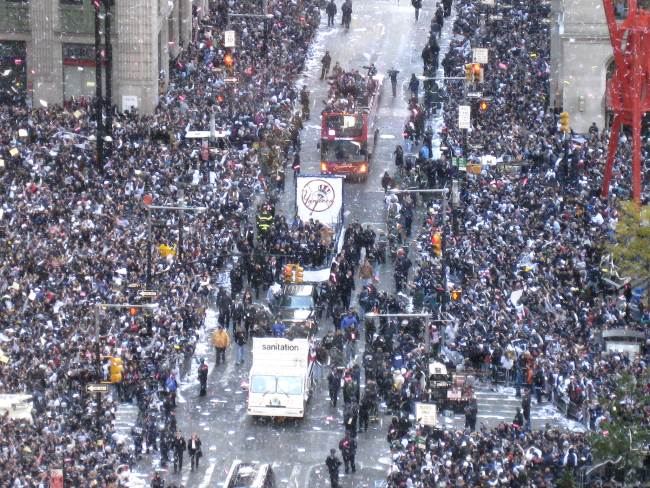
Starting with an impromptu parade on October 28, 1886 to celebrate the dedication of the Statue of Liberty, Broadway has always been the place for parades. A parade could be to honour a visiting head of state or someone with a major achievement, or to celebrate a victory in a sports event or anything else significant. Thus did Broadway get the sobriquet ‘Canyon of Heroes’.
 
parade2

The new generation may not – will not – remember the quarter inch ticker tapes that carried the stock prices from the exchanges and spewed out by the stock ticker machine. As the lower part of Broadway has always been lined on either side by financial institutions and brokerage firms, they had a lot of this ticker tape lying around. So what was more natural than showering some of it on the procession going down on Broadway… yep, just like confetti! And thus did the parades on Broadway get the name ticker tape parades.
 
parade3

These days, the ticker tape parades go from Battery Park to the City Hall. And each parade is commemorated by a granite strip with the name of the person being honoured set into the sidewalk of the Canyon of Heroes.
 
amelia-two

Only, instead of the ticker tape, paper from the shredder is most often used!
 
nehru
Along the Broadway are Wall Street, Zuccotti Park of Occupy Wall Street fame, Trinity Church, City Hall Park, Union Square, Times Square, Columbus Circle and Central Park, Columbia University, The Cloisters, and a host of other interesting places.
 

trinity

Trinity Church

And these days Broadway has become a synonym for theatre in NYC! Mainly for the reason that the theatre district where the majority of the playhouses are located, is right on the Broadway. And from there, you have off-Broadway and off-off-Broadway performances as well! And if you want to snag some discount tickets, that can be done at the ticket kiosk at Times Square too!
 

tkts

Ticket booth at Times Square

zuccoti

Zuccotti Park

food

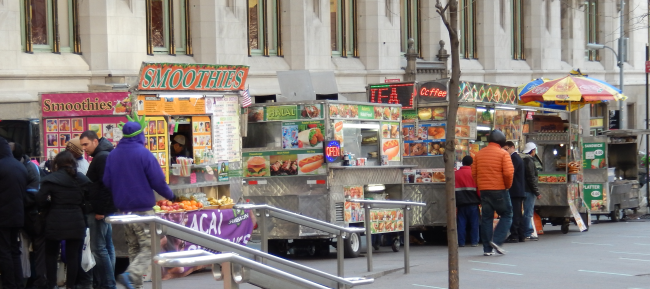
Food trucks along Broadway, downtown

A random thought… wouldn’t it be great to do a full walking trip of the Broadway, from one end of Manhattan to the other? Say for example, start at Broadway Bridge at the top of Manhattan and walk all the way to Bowling Green… sounds awesome! So here it is… before this summer is over, I’m going to do that. It takes me around 15 minutes to walk a mile; 13 miles in a day will be easy-peasy! One more item added to the summer fun!


~Ria

16 May 2014

Back to downtown for a lunch time walk…

Soon after I had moved to the mid-town office (The salt mine I work at has offices all over the world!), I had taken a happy break from winter, going to work from our Bangalore office. So it had been a while since I was in downtown New York. Okay, five months, but this is New York and a lot can happen in five months! And recently when I went to meet a few friends there, it was like a new place… all exciting and interesting! And of course, I went on a lunch time walk. So this is for all my friends who used to share that walk in times gone by…
 
path-tunnel

The first noticeable change was the new connection to the Winter Garden from the World Trade Center PATH station. Gone is the bridge and corridor overlooking the construction site at WTC. The high ceilinged concourse is stunning, with the pillars arching over, way above the pedestrians. Designed by Santiago Calatrava, the concourse is part of the transportation center at the WTC, scheduled to open in 2015. The concourse will have shops lining the sides when whole construction is complete.
 
winter-garden

The Winter Garden is also being redone, of course, without changing the iconic basic structure.
 
trees-winter-garden

The trees outside the winter garden always reminded me of candelabras in their winter state. And in the next week or so, those branches will be adorned with green leaf clusters, obscuring the structure of the branches, but providing such delightful shade to people taking their lunch break under them.
 
tree-with-buds

The trees have already started sprouting buds, even as last year’s dry seeds are still hanging on.
Squirrels are already busy starting their collection for the next winter. Come on buddies, don’t worry… winter is sooo far away!
 
squirrel1

It is a wonderful walk along the tree lined walkway to the battery Park, with river Hudson on one side.
 
battery-walk2

I love the blue lights along the South Cove where one can climb up on the viewing towers to get a good look at the Hudson traffic and the Statue of Liberty.
 
blue-lights

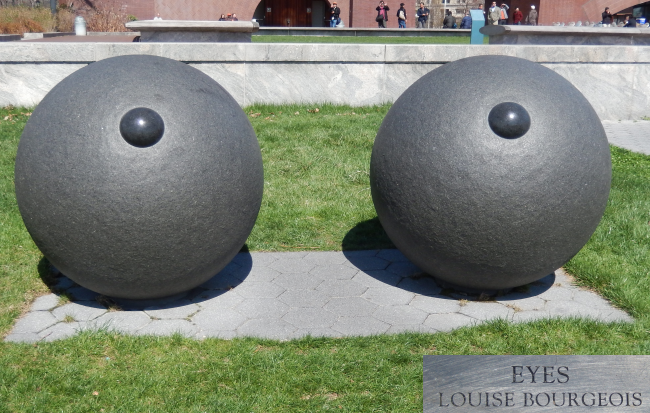
And there are interesting art works as you continue past the South Cove. One of the art works always aroused speculation among us though its name was clearly written. I have seen people looking at it from all angles to see what the artist wanted them to see, instead of what a first look told them. Here is the artwork for you…
 
eyes

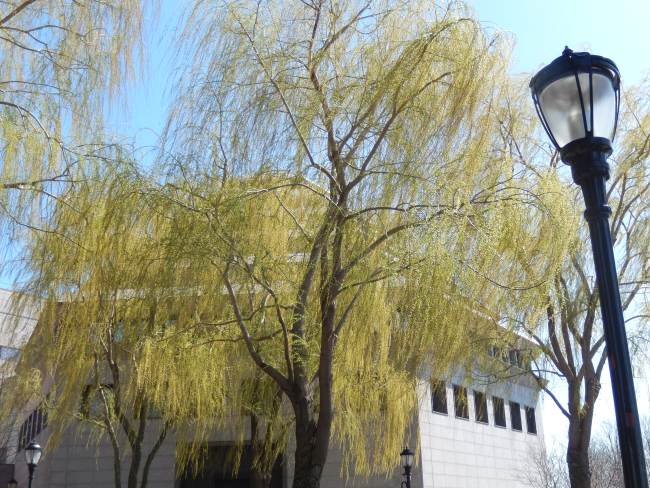
There is one willow tree that I take note every year; it is one of the first to sprout and it is ever beautiful with its delicate tresses waving in the breeze from the river.
 
weeping-willow

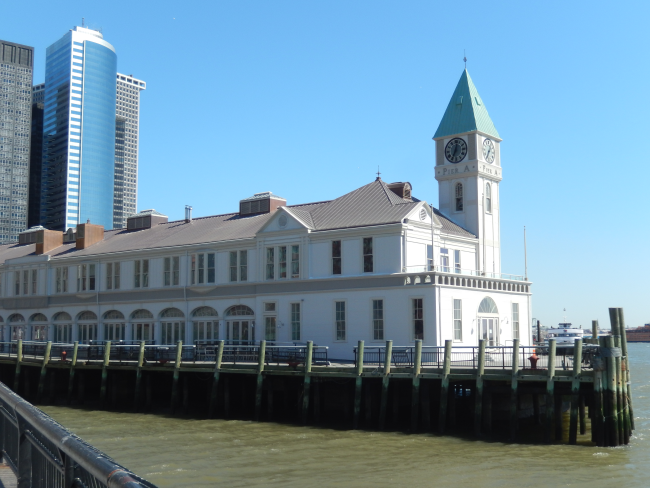
At the corner of Battery Park is Pier A, originally constructed in 1886 and in use variously by the New York City Department of Docks and Harbor Police till 1992. It is the oldest historic pier in the city and is a designated New York City Landmark. Currently, it is being restored and will be home to an oyster bar and restaurant.
 
pier-A

Charming is the apt word to describe the Manhattan skyline from this point. The red stones of the old buildings and the blue reflection on the new 1 World Trade Center tower look so well matched.
 
skyline-with-tower

From the Battery Park, I turn to Broadway and the walk back. Of course, saying Hi to the Wall Street bull.
 
wall-street-bull

The history of that bull and how it came to be in that spot is a story connected to the illustrious past of this financial capital of the world. Another time…
 

~Ria

09 May 2014