Author Archives: Min

Abyssinian Ground Hornbill

When we talk about birds, the Abyssinian Ground Hornbill is one bird that has fascinated me ever since I first saw one at Murchison Falls National Park, many years ago. Since then, I have seen these beautiful birds a number of times on subsequent trips to Murchison and they always make me smile.

P1

P4

Hornbills are generally sedentary and live within a defended territory. The Abyssinian Ground Hornbill is a large turkey like bird that is normally found in the sub-Saharan African savannah, north of the equator. An adult bird can grow to around one metre tall and weighs about 4 kg. It has a large bill topped with a casque, a helmet like structure. Despite their wingspans these birds very rarely fly and are adapted to ground dwelling, hence the name Ground hornbill.  Abyssinian Ground Hornbills also have wattles (a fleshy pouch hanging from the throat, similar to a turkey or chicken). From these pouches, one can distinguish between a male and female bird as males have a bright red pouch hanging from their throats whilst those of females are blue. These birds  always seem to me like they are dressed up for a fancy party not only because of their dark , shiny feathers and brightly coloured pouches, but also their long eyelashes, which are actually modified feathers designed to protect their eyes from dirt and debris.

P5

I learnt many interesting things about these birds from a Uganda Wildlife Authority guide who had accompanied us on our game drive in Murchison Falls National Park. He told us that the Abyssinian ground hornbill mated for life, which is interesting but one hears that about a lot of birds. What was most fascinating (for me at least, not sure about the others with me!) was finding out about how these birds lay eggs and look after their young. In the case of a regular hornbill, the female lays eggs in the cavities of tree trunks or any other caves or crevices of a tree. The male hornbill then builds a cover over the cavity with mud and twigs and the female does not leave the nest until the eggs are hatched. Naturally, it is the duty of the male bird to bring food for his partner during this time. So if something were to happen to him while he was out fetching his bird wife food and he gets killed, the female will also die of starvation. But Abyssinian Ground Hornbills do this in a slightly different way. They do not seal their nests at all, and they are left open during incubation so the female can come out for preening and excretion. Not for anything else though, the male still has to bring food back to the nest.  Once the eggs are hatched, the female remains in the nest with the chicks for a week and then joins the male in finding food for the young. If there are two chicks the younger one is usually ignored or starved.  Chicks are ready to leave the nest after 3 months. These nests are normally permanent under favourable environmental conditions.


P2 AGH

P3 AGH
The Abyssinian ground hornbill is listed as a species of Least Concern by the International Union for Conservation of Nature (IUCN) due to its large population. So I don’t have to worry about them disappearing anytime soon. 🙂
~Min

20 Mar 2014
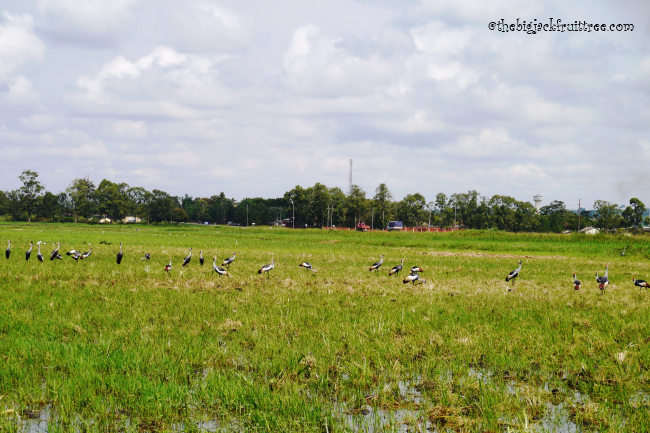
Crested Cranes – the crowned beauties of Uganda

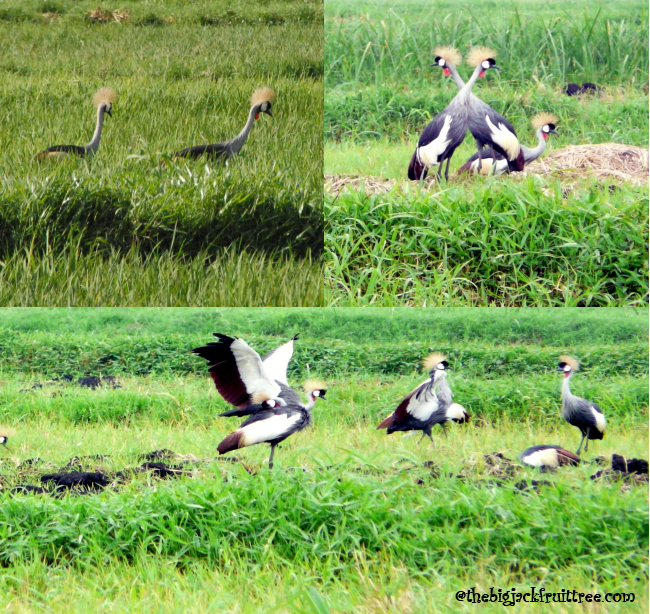
When you plan to write about different birds at Kibimba, Bugiri district in Eastern Uganda, it’s quite appropriate to begin with Crested Cranes, the national bird of Uganda. It’s one of the most cherished birds in Uganda and features in the country’s flag and coat of arms.
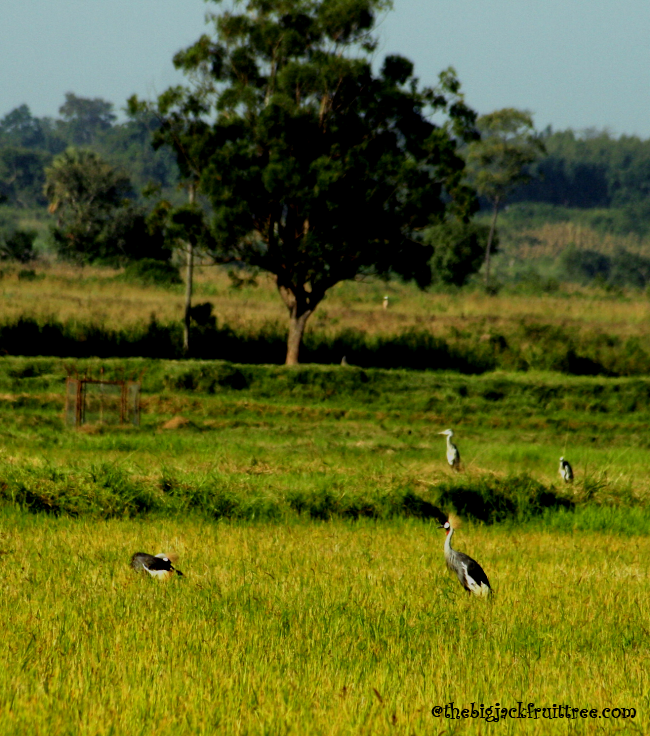
At Kibimba we always get to see flocks of them in the fields as they prefer freshly ploughed fields to tall grass and plants. They also prefer wetter habitats near water bodies for nesting. Crested Cranes are a friendly, gentle and peace loving bird, which is pretty much true about the Ugandan people as well. 🙂

Crested Cranes (3)
The large flock of crested cranes moving slowly and gracefully along a field is a beautiful sight. You would think you could just walk up to them and touch them. But as you move towards them, they too will move at the same speed. So that even after following them for a long time, the distance between you and the flock will be exactly the same. Only if you make any threatening move or sound would they rise up and fly away. Clever birds indeed.

crested crane close up
The scientific name of the grey Crested Crane is Balearica Regulorum. Their body plumage is mainly grey and wings are predominantly white. Younger birds are greyer than adults. These cranes are tall, generally over 3 feet, standing on slender black legs. Their necks are almost as long as their legs. The black velvety forehead, yellowish golden crest and the bright red wattle make the crested crane an elegant bird. These three colours on their heads make Uganda’s national flag.

courtship
The crested cranes are a monogamous species; they have only one breeding partner through their entire life. The crested cranes are known for their spectacular dancing. Dancing is an integral part of their courtship. In East Africa the mating season is throughout the year, peaking during the rainy months. During their mating dance two cranes hop and jump gracefully with each other, with their wings partly spread. Then they open their wings and jump in the air. Also can see them running around each other during courtship. It’s quite obvious that traditional dances have adopted many movements from their dance.

flock closer

Crested cranes have a loud, booming two note call  except when they are calling their family; they use a guttural purr when calling to their chicks or mates.

Crested Cranes are omnivores . They feed on cereal heads, grains, new tips of grasses, insects, frogs, lizards etc. They stamp their feet hard on the ground when they walk across the ploughed fields. This flushes out the insects which they pick and eat quickly.
The crested cranes generally live up to 22 years in wild and 25 years or more in captivity.
Unlike other cranes, crested cranes are the only cranes that roost on trees as their hind toe is adapted for grasping. They are the earliest evolved species among cranes which is evident from the animal fossils of Eocene period (about 58 to 37 million years ago).

Enjoying a stroll with other cranes

Enjoying a stroll with other cranes

According to the International Crane Foundation, crested cranes are an endangered species and the population has declined 50 – 79 % for the past 45 years. They are most abundant in Uganda, Kenya and Tanzania.

~Min

19 Feb 2014

Performance by Ndere Troupe – A visual treat indeed!

Dance has always been a passion for me. However, my first encounter with dance did not go well. 🙂 When I was just three years, I was put in a dance class run by my school as an after class activity. To my surprise I still have a vague memory of that class packed with 25–30 children of different age groups, trying to copy what the instructor was doing. I got so disillusioned after the first class that I adamantly refused to go to the class any more. Then at the age of eight I had the opportunity to join a professionally run dance school (apparently my parents recognised the interest I I have in dance) and from then onwards dance has always been a part of my life. Never miss a chance to perform or watch various dance genres.
Dance has always been an important part of celebrations, ceremony and entertainment. It’s difficult to say when dance has become a part of human culture. The Egyptian tomb paintings depicting dancing figures from 3300 BCE and 9000 year old Bhimbekta rock shelters paintings in India indicate the prevalence of dance even in prehistoric times. Dance figurines were a permanent feature of ancient temple architecture.
Dances are usually performed as a mode of expression, as part of healing rituals or as an offering to God. Dance forms are also used as a tool to communicate with people about social evils, prohibiting the progress of the society. Ballet, bharatnatyam, hip hop, rumba belly dance, calypso, gigue, lap dance… there are sooo many varieties of dance we enjoy today.
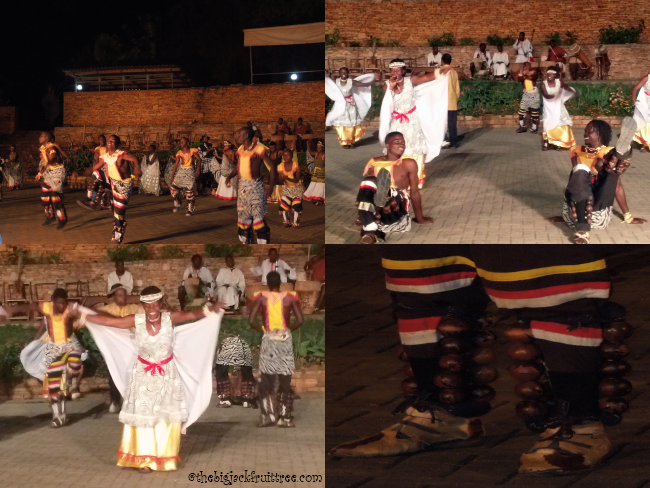
The entertaining performance of traditional Ugandan dance and music by Ndere Troupe is what initiated these thoughts on various dance forms. I’d watched traditional Ugandan dances many a time. But getting to enjoy the playing of musical instruments, singing and dancing in a serene ambience in the amphitheatre at the Ndere Centre was an entirely unique experience. To quote from Ndere Troupe’s website, “In Africa written words didn’t exist, thus Africa’s cultural history, literature, knowledge and wisdom were recorded and passed on to succeeding generations through the medium of performing arts music, dance, storytelling and poetry.”


dances of Uganda 1

The programme started with playing of various instruments and singing.

dances of Uganda3a


dances of Uganda2

Kiganda dance from Buganda was originally only to be performed by the people of Obutiko clan and only in the palace.

dances of Uganda5dance of Uganda6

Dance of Bunyoro tribe. Bunyoro tribe belongs to the Toro region in Western Uganda. This is a courtship dance. Men and women sit around a fire reciting poems. Then men start dancing in front of each girl and the luckiest one gets chosen.

dance of Uganda7

Banyankole are the people who belong to the Ankole tribe, one of the four traditional tribes of Uganda. They are from South Western Uganda. This region is also famous for the Ankole cows with their distinctive curved horns.

dance of Uganda8

Dancers of Alur tribe hail from north western Uganda. One of the main instruments they play is called an Adungu.

dance of Uganda10
These are the dancers of the Acholi tribe. They belong to the Luo Nilotic ethnic group from northern Uganda.

dance of Uganda11

The percussion ensemble from Burundi , another east African country, was quite amazing. They came in balancing the heavy log drums on their heads drumming and singing. These drums are made from the trunks of a tree which grows only in Burundi.

dances of Uganda9

Intore (the dance of heroes) is the most famous traditional dance form of Rwanda, another east African country.

collage
It was a visual treat indeed. This post will not be complete unless I mention the tasty Ugandan meal which we all enjoyed after the performance.

Min

10 Feb 2014

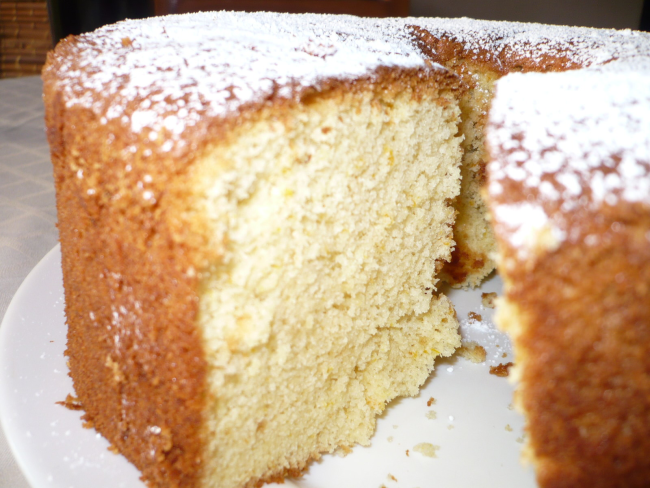
Orange Chiffon Cake

It’s still fresh in my memory… the white, airy and light cakes that my sister used to send me many years back. I did not know then (rather I didn’t bother to find out) that it was an angel cake. Later when I got hooked to baking, I always wanted to bake chiffon cakes and angel cakes. But couldn’t for want of a tube pan. Finally this Christmas Gaia brought me a 10 inch Wilton tube pan. Though I wanted to make a chiffon cake before she went back, couldn’t manage it as we were very busy with other plans.

firstslice

So I was waiting for a chance to use the pan. And when our wedding anniversary came around on the 2nd of Feb, it was the perfect occasion to make an orange chiffon cake. Moreover the fact that my husband neither likes iced cakes nor chocolate cakes is all the more reason to bake an orange chiffon cake.

ingredients


Chiffon cakes are very light and airy and made with lots of eggs, oil, sugar, flour and baking powder with any additional ingredient to flavour the cake like orange, lemon or chocolate, as per your preference. The use of oil instead of butter makes the cake really moist and keeps the cake soft even after a few days in the refrigerator. I used both freshly squeezed orange juice and orange zest to achieve the fresh orange flavour in the cake.


eggs


Chiffon cakes attain their fluffy texture through stiffly beaten egg whites folded into the cake batter just prior to baking. A few points to bear in mind whenever egg whites are beaten to stiff peaks… Separate the eggs into whites and yolks as soon as they are taken from the fridge. Beat them after they reach room temperature using a handheld electric beater. Start with slow speed and change to medium when it still in liquid form. Beat for 3-4 minutes to get soft peaks. Add superfine sugar, a little at a time, and beat till stiff peaks are formed. Add the beaten egg whites into the batter by the cutting and folding method in 3-4 batches.


cutandfold


If you don’t have superfine sugar at home just run regular sugar through the food processor for a couple of minutes before using in the recipe.

Once the batter is ready pour it into an ungreased tube pan. Ungreased pans are used in chiffon and angel cakes because the stiffly beaten egg whites need to cling to the pan to rise. Once the cake is done invert the pan and let it rest in that position for a minimum of 1 hour. If you allow it to cool without inverting the pan, the cake collapses resulting in a lumpy mass.


oc-cakedone


Once the cake is completely cooled, run a knife around the sides of the pan to free the outer section off the cake. Then run the knife around the tube and the bottom as well to get the cake released from the pan. Now leave it on a wire rack for further cooling.


finalcake
~Min

divider-recipe


Ingredients

All Purpose Flour 248 grams
Salt 1/8 tea spoon
Baking Powder 1 tablespoon
Corn flour 42 grams
Vegetable Oil ½ cup
Superfine Sugar 300 grams
Eggs 7
Vanilla Essence 1 teaspoon
Orange Juice ¾ cup
Orange Zest 2 tablespoon

 Directions

Preheat the oven to 165 degree celsius.

Separate the eggs into yolks and whites and leave them aside to reach room temperature.

Sift all the dry ingredients except sugar together twice.

Mix 250 grams of superfine sugar with the sifted flour.

Beat the egg yolks with vanilla essence.

Make a well in the flour sugar mixture, and add the beaten egg yolks and other wet ingredients except egg whites.  Mix together.

Beat egg whites till soft peaks are formed, add the remaining 50 grams of sugar little by little and beat at medium speed till stiff peaks are formed.

Cut and fold the beaten egg whites in three or four batches into the batter.

Pour the batter into an ungreased tube pan and bake in a preheated oven for 45 – 50 minutes.

Invert the pan for one hour once it is removed from the oven.

Once it’s cold remove the cake from the pan.

Finally dust the cake with some icing sugar and serve with whipped cream or fruit couli.


Divider2-LR-4px


05 Feb 2014

Making it from Scratch – Candied Peels

candied peel 2


I always prefer using home-made ingredients in cooking, if possible, to buying them from shops. I can vouch for the quality of the spice mixes I make for various dishes. Now coming to our subject “candied peel” which literally means making candy out of peels.


candied Peel 1


Candied peels can be made using peels of citrus fruits like lemon, orange, grapefruit etc. Candied peels are generally used in cakes, puddings and can enhance a cocktail as well. You can also munch on them whenever you feel like.

The first time I tried to make candied peel was when I needed some for a cake and I was in a location where I couldn’t get out and buy some. I used oranges and it was a success. Since then, I have never bought candied peels. It’s a good way of making use of the peels as well. The general principle of the process is to boil the peels in strong sugar syrup and then dry off any moisture left.


candied peel 3


Make sure firm oranges are selected for this, otherwise peeling the skin off the fruit becomes messy. Use a sharp tipped knife to core the skin into segments and then peel off. Remove the pith as much as possible to reduce the bitterness. Cut them into ½ cm strips before boiling in water.


candied peel 4


The bitterness is further removed by boiling the peels in water before candying. Boiling the peel not only makes it soft and porous (to absorb more sugar) but also removes any pesticide residue.


candied peel 5


Sugar syrup made for this purpose is a sugar to water ratio of 2:1. Once the peel strips are boiled and removed from the syrup and left to dry on a wire rack, the remaining sugar syrup can be used for making cocktails or to moisten cakes before icing them.


candied peel 6


My candied peels were dried overnight and ready to use the next day.

~Min

divider-recipe

Ingredients

Orange Peel – 2 oranges

Granulated sugar – 2 cups

Water – 1 cup

Granulated sugar – ¼ cup

Directions

  1. Peel the skin off oranges, remove the pith and cut into ½ cm strips.
  2. Add this to a pan of water and heat till the water is boiled. Drain.
  3. Repeat step 2 once more.
  4. Add the drained orange peels into pan with one cup of water and add sugar. Heat the mixture till it starts boiling.
  5. Once boiled reduce heat and let it simmer for 30 minutes.
  6. Remove the peels using a slotted spoon into a bowl, sprinkle sugar and spread them on a wire rack to dry completely.


recipe-divider

29 Jan 2014