Travel

Air travel… then and now

I love long distance plane travel… This might be hard for many to fathom. And they do have some valid points too. The narrow seats with hardly any leg room, almost inedible meals, the long hours spent going through security… all true. But for me, these are all minor matters. Especially when compared with the luxury of the exclusive time I get to spend without any outside interference. Totally personal time that no one can encroach upon. Beyond the reach of cell phones, conference calls, and business meetings… And beyond the call of pending household chores, which have a way of bothering me even when I have no intention of getting onto them! 🙂
 
Me and my book, curled up in the window seat… and my mind wandered to a long gone era of luxurious airline travel…
 
The jetliners that started flying in the late 1950s changed the scene of commercial air travel. The flight time from New York to London was promised to be a mere six and a half hours in 1958, as opposed to the 17 hours 40 minutes in 1946 and 10 hr 50 minutes in 1956!
 
This Pan Am commercial from 1954 features the prototype of the Boeing 707 jet clipper that started commercial flying in 1958.
 
Suddenly, air travel became a doable thing. And the airlines of the day came out with fabulous commercials to persuade the public to use the new means of travel. The TV commercials of Pan Am and TWA are full of champagne, fine food and perfect service.
 
Take a look at this TWA commercial… a flight from the east coast to Los Angeles.
 
In addition to all luxuries, it even promises pleasant company. “Everybody nice and friendly, like we knew each other.” And maybe to prove how air travel brings out the best in everyone, it even has a kinda fairy tale ending with… no, I don’t want to spoil it for you, do watch the video. 🙂
 
Air travel apparently was an occasion, an event, with people dressing up in their best finery as if they were going for a party. In fact, the commercials exude a true party atmosphere with everyone smiling and laughing and circulating with glasses in their hands. Having lots of fun. It seemed like it was more about living high, than getting from place to place. And today’s air traveller is left wondering whether it is all indeed happening within an airplane…
 
And the food… white tablecloth, silver trays, hors d’oeuvres… even the dinner was served off a silver cart, on china, with designer flatware and linen. And the meals came piping hot from full-fledged kitchens, complete with freezers and convection ovens.
 
And get this… the early jets had lounges with huge windows, sprawling seats, and buffets, where coach passengers could socialise. Some of the flights even had actual film projectors to replicate the movie theatre experience. Even when the lounges were removed in 1973/74 to accommodate more seats, portable service bars were provided in an attempt to retain the freedom of movement. Sigh… gone are the days…
 
And the rest rooms… nothing like the teeny little spaces where you are bound to hit your head somewhere unless you are a hobbit… Separate lounges for men and women, women’s lounges with vanity tables and settees and large mirrors.
 
When looking at these old time commercials, what impresses me above everything is the space… the abundance of it. The seats were fabulously wide with legroom unimaginable today, and one could move around between seats as seat belts were optional in those days!
 
Of course, air travel those days was only for the privileged few as the cost was astronomical and beyond the reach of the average Joe. Now, it has become more affordable. And with the competition among the airlines for your dime, it could get even cheaper. More so, if you are willing to forego comforts (basics?) like an assigned seat or a bathroom… that is, if you go by the plans put out by some of the airlines… 😉
 
P.S. Did you know that during the early years of air travel all stewardesses had to be certified nurses?
 

~Ria

10 Mar 2014

41 Days of Summer…

… right in the middle of the worst winter in the last 20 years! That is a true luxury, especially for a person like me who starts shivering at the first hint of a cold breeze. Add to it awesome spicy food of a wide variety… that too, without a single day’s toil in the kitchen… Now you know why I am constantly smiling these days! 🙂
 
This was a work combined with vacation trip. The swanky new office in a brand new technopolis near HAL in Bangalore was very impressive with naturescapes and waterfalls all around. The moment I started snapping some pictures, one of the security personnel at the the entrance came running… “Ma’am, no photos please…” “Not even of the flowers in the garden?” “No Ma’am, all photography is prohibited”. I really laughed out loud… it was no use telling it to the security man, but I had to say it… “this is the number one news and photo agency in the whole world, and we ban photography on our own premises? Interesting!”
 

office-flower

Stolen photo of flowers 🙂

The whole trip has been a continuum of good food; some great, some really great. It is difficult to pick favourites from the lot, but standing out in my memory are the traditional thaali meal at Rajdhani, a taste of Goa at Fishermen’s Wharf, Manglorean food at Parika, Mediterranean at Byblos, Tex-Mex at Habanero, Mughlai at Umerkot…
 
Amazing among the places I managed to visit during this trip are Ranganthittu bird sanctuary, about 75 miles from Bangalore, and the fishing port at Beypore, Kerala. More about them later.
 

ancient-tree

Ancient tree by the roadside

And the drive through the Western Ghats (9 hairpin turns!) will never lose its charm. Though the waterfalls were not very active despite the bountiful monsoons, the view of the mist clad mountains and valleys was as enchanting as ever.
 
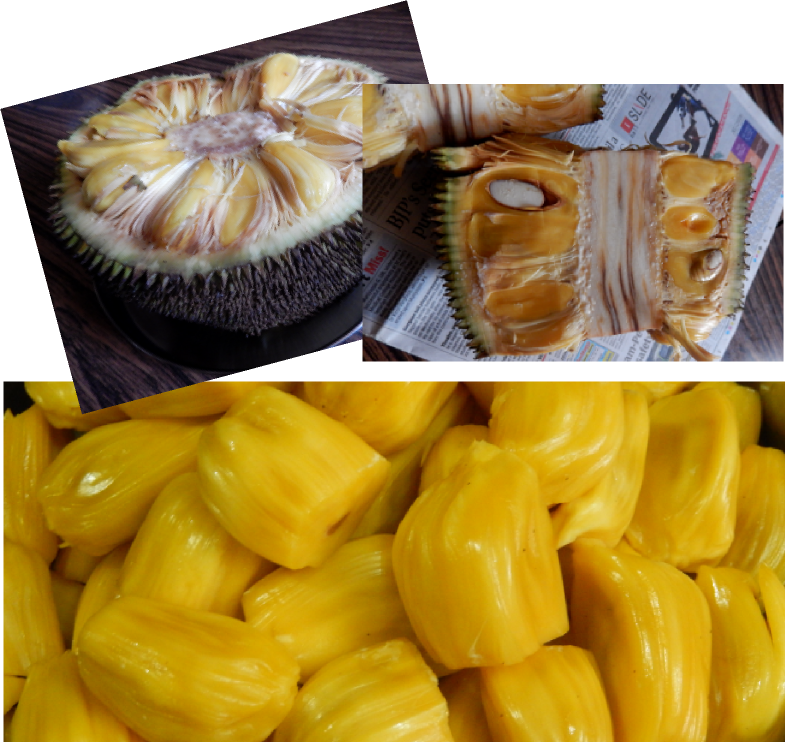
And yeah, I got to eat sweet jackfruit, one of my favourite fruits ever! Though it was early in the season, I found a fruit seller on the road side selling it, and grabbed some. Delicious!
 
jack

Sooo… tonight I get on the plane to go back home. The last punch of winter is waiting for me, I know. Remember, some of the heaviest winter storms in the past have been in March. It will be great to have a taste of true winter knowing that it won’t last too long and that spring is right around the corner. After all, how will we appreciate summer if there is no winter? 😉
 
Just remembered, daylight saving time will become effective the day I land at Newark Liberty! I can get acclimatised to the new time and get out of jet lag at one go! 🙂

~Ria

06 Mar 2014

In search of tribal treasure…

The car flies along the Mysore road. My cousin Bala is driving and the roads are delightfully empty as it is a Sunday morning. We are headed for the Lambani tribal settlement on the outskirts on the city. This tribe makes beautiful metal jewelry and embroidered cloth with mirror work, well known for their excellent craftsmanship. We are hoping to see the making of the lovely artefacts and to buy some, if available.
 
The progress is not so fast though, as we have to stop frequently to ask for directions. Many of these stops turn out to be exercises in character assessment as it seems inconceivable that anyone would willingly say ‘I don’t know’ around here. So one has to gauge whether the directions given are anywhere near dependable, based on the person’s apparent confidence, his body language, whether he looks you straight in the eyes…
 
From the highway we turn onto a paved road; just barely paved. Soon the going gets worse as the paving disappears from under the wheels and the terrain gets increasingly tough. Soon the path becomes two ruts hardly visible among the high grass, climbing up and down hillocks. The vehicle is lurching from side to side, the bottom often touching the ground with scraping noises. I’m getting more and more uneasy, as I’m the instigator of the plan. The other occupants of the car – Min and Bala’s wife Su – have this scared look on their faces and are looking uneasily around.
 
Soon the trees on either side are brushing the car and we can hear scratchy scrapy noises. Any indication of a road or path is almost gone. There is all kinds of discussion in the car… what if we get stuck somewhere, how will we turn the car around, what if we are not welcome where we are going… Su and I try to dissuade Bala from going any further. And Min looks like she is ready to scream at the first indication of trouble.
 
But apparently Bala is looking for adventure. We have come this far; now we don’t want to turn back without seeing the village… the road is sure to get better further along, says Bala the eternal optimist.
 
All of a sudden, the car bursts out into a clearing. Far off across the flat ground we can see some kind of construction. Just as we start looking around from the now stopped car, there is this loud whoop and flurry of action. A bunch of men, all dressed in tribal finery and shaking huge spears, rush towards the car from across the clearing. The loud shouting and yelling fill the air, combined with the noise of their running feet. Bala makes a tight circle with the car and in the blinking of an eye, we are driving helter skelter out of that clearing. As the car turns, we catch a quick glimpse of a huge cauldron, steam rising out of it, set on three gigantic stones with a roaring fire under it, in a corner of the clearing. It is being stirred by a bunch of women who are standing on stilts so that they can see into the pot. That is all we see and that is enough to set us out of there at the speed of thought…
 
Aah… I guess my imagination ran away with me… The story up to the point where we burst into the clearing is all true. We find ourselves in a grove of young mango trees, with some construction happening at one end of the grove. We speak to the people there… yes, we are on the right track; the Lambanis live around the area. No, they do not carry on their traditional arts anymore, at least not around there. And at this time, mid-morning, most of them will be at their work places.

mangoes

Young mangoes – mouthwatering stuff!

So, a wild goose chase, but we thoroughly enjoyed it! 🙂 And the day provided many other enjoyments as well. On the way where we stopped for breakfast, we got to taste moode idli, a delicacy of the locale. Made of a mix of rice and lentils, it is steamed wrapped in pandanus leaves.

moode-idli

Moode Idli

Also, we stopped at Janapada Loka, a cultural center set up to nourish the arts and crafts of Karnataka. Founded in 1994, it is located on the Bangalore-Mysore Road on a 15-acre campus.

statues

Statues inside the gate of Janapada Loka

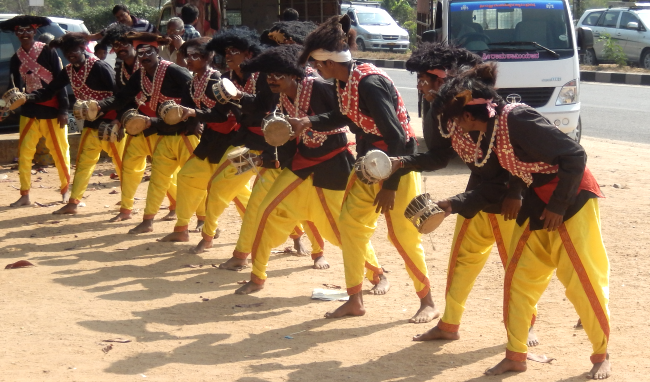
Artists in residence perform and conduct training in the traditional dance forms and music. Bangalore University has recognised Janapada Loka as a research centre.

dance-group

Dancers at the Janapada Loka

dancers

The day we visited, there was a Yakshagana performance scheduled at Janapada Loka. But unfortunately, we couldn’t stay for that as we had to go see the Lambani settlement… 🙂

~Ria

Divider2-LR-4px

With sincere apologies to the Lambani people. The above story is no indication of the behaviour of the friendly and peaceful tribes; it only proves the influence of popular fiction on my imagination.

Divider2-LR-4px

24 Feb 2014

Namma Metro… Bangalore ahead…

Last time I was in Bangalore, construction was going on all over the city for the Metro transit system, named Namma Metro meaning Our Metro. As you probably know, Bangalore is the tech hub of the country, with a population surge already way beyond its infrastructure can support. And extended traffic snarls during the peak hours are as predictable as the sunrise every morning.

All this digging in the middle of the roads added considerably to my commute times. It was easy for me to not get irritated by this as it was a matter of only three weeks, after which I would be going back to my PATH trains… And I had a grand new Metro system to look forward to on my next visit… 🙂

Hence I was a bit amused by the venting of the cab driver one day on my way to work. We were stopped at a traffic signal and had to inch forward missing at least two greens. ‘Madam, who are they building all this for? Can the ordinary people afford the fares of the Metro? Never. All it has done is fill the pockets of the politicians… they all get rich, a white elephant Metro will sit there, and god alone knows whether it will even be completed!’ And I had to wonder whether his frustration had anything to do with the possible competition his trade would face from an efficiently run, on time Metro!

The first stretch of the Metro – from M.G. Road to Baiyyappanahalli – was inaugurated in October 2011. This visit, I took a ride on the Metro on that same stretch. First impression… Wow!

Metro1
The stations are expansive, spic and span, and maybe because I entered around 10.30 am, deserted. The personnel in charge of the strict security screening of all passengers are extremely courteous. Energy saving escalators, helpful signs… above all, everything spotlessly dust free; it is a bit hard to believe you are still in Bangalore! 😉

Metro5
The train compartments are of international standards and not at all crowded, especially at the non-peak hour that I travelled. Now I do have to check out the crowds during the peak hours, of course!

Metro4
To my delight, the trains run on elevated rails, not underground. And provide a wonderful view of whatever can be called the down town on the M.G. Road – Baiyyappanahalli route.

Two things to do next… check out the longer Malleswaram-Peenya stretch and check out the downtown stretch during peak hours. Another day…

~Ria

21 Feb 2014

Sunset at Kappad Beach

Global awareness, global warming, global politics, global citizen, global governance… the word ‘global’ has become part of our daily conversations. It is hard to imagine a world where you cannot pick and choose goods and products from all over the globe. We are truly enjoying the fruits of globalisation. I was reminded of a significant historical incident on the route to this globalisation, when I visited Kappad, a beach on the Malabar coast on the south western shore of India.kappad-beach2
In 1453 Ottoman Turks, under the leadership of Sultan Mehmed II, conquered the city of Constantinople, after a siege that lasted 50 days. With the fall of Constantinople (the city was renamed Istanbul), the Ottoman Turks cut off the overland caravan routes that were essential to the spice trade between Europe and countries in Asia that produced spices like cinnamon, cassia, cardamom, ginger, and turmeric.
Meanwhile, the demand for spices which were scarce and costly kept growing in Europe. In addition to flavouring food, spices were valued for their medicinal qualities and as a status symbol.
Finding a sea route to India became an immediate need. Tales carried by travellers, of the fabulous wealth of the East, also fuelled the quest. It was under these circumstances that King Manuel of Portugal commissioned an expedition to India under Captain-Major Vasco da Gama, who set out with four ships on July 8, 1497. After much hardship, Vasco da Gama landed at Kappad near Calicut (of Calico fame) on May 20, 1498. Thus was started an era of strife and competition and warfare among the European nations for mastery over the land and wealth of the East. At the same time, it also was the beginning of cultural and commercial interactions on a global scale.kappad-beach1
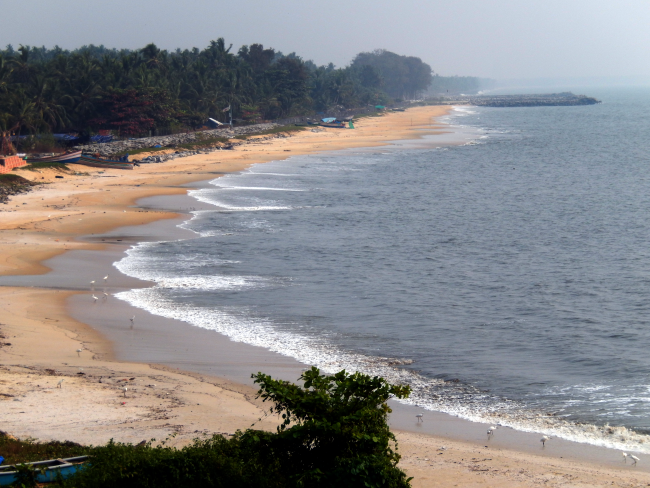
Calm, serene, peaceful… these are the words that best describe Kappad beach today.
The place is very beautiful and quite. Rocky formations extending into the ocean on either side of the sandy beach add an extra charm. The huge rocks can easily be climbed and provide wonderful views.
On a regular day, the beach is not crowded at all.
It is glorious to sit on the rocks and watch the sun setting in the Arabian Sea.

The old temple on one of the rocky formations is quite charming.temple
If you are an early bird and get to the beach, in the morning when the fishermen’s boats land, you can buy almost live fish, including the fabulous pearl spots.

Pearl spots taken through their natural progression (unfortunately, not from Kappad)

Pearl spots taken through their natural progression (unfortunately, not from Kappad)

A pillar near the beach commemorates Vasco da Gama’s landing at the Kappad, which used to be known locally as Kappakadavu. pillar

~Ria

divider-recipe-end

Interesting note
The early stories about the mysterious East were so full of fantasy… In the 7th century, Europeans believed that pepper grew on trees guarded by serpents. The only way it could be harvested was by setting the trees on fire, which would frighten the serpents away. May be that would have explained why pepper was black… 🙂divider-recipe-end

07 Feb 2014