World’s greatest

A Castle Fit for a King

After procrastinating for more than two years, I finally ventured out to see Casa Loma, a historical building which is now a cultural landmark for Toronto. I have always wanted to do this since I came here as I have heard a lot about the place. So, my friends and I planned this as a fun activity on a rainy day which was also a good way for us to stay indoors yet not be bored.

Casa Loma

Our day was pretty productive and Casa Loma turned out to be way more beautiful than I anticipated. Firstly, there was ample parking and that always scores high in my list of impressive things. 🙂 Secondly, there was more to see inside the building than I had expected. My prior expectation was based on the information that Casa Loma was not really a king’s castle but somebody’s erstwhile residence, hence does not bear the ornamentation of a palace. This was proved wrong.
DSCN0269

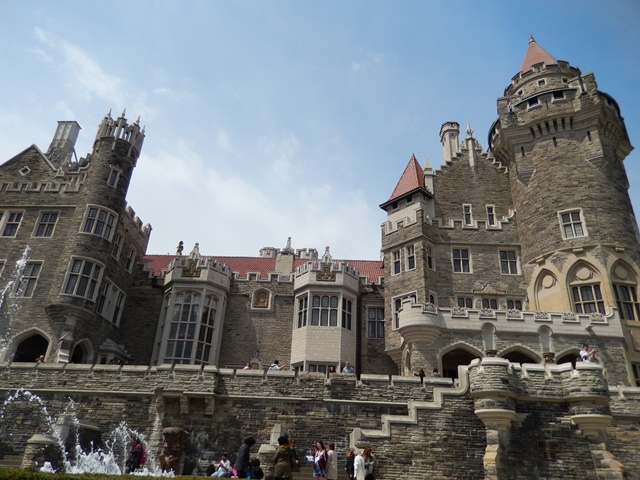
Built like a castle, it is a heritage structure that is more than a century old. Following Gothic-style architecture, it used be a villa owned by a prominent figure of those times, Sir Henry Mill Pellatt. Since we weren’t sure of who he was, we sat in on the documentary that was being screened in one of the rooms of the castle.

Sir Pellatt was a Canadian financier and soldier for The Queen’s Own Rifles of Canada. His most significant achievement was that he brought hydro-electricity to Toronto. He commissioned architect, E. J. Lennox, who is known to have designed 70 buildings in Toronto, including the City Hall, to construct this huge mansion.

Queens

Sir Pellatt liked to throw lavish parties and entertain guests in style and looking at the palatial nature of the rooms, I wished I could have attended one of those parties. I was reminded of the book, The Great Gatsby, written around the same time, by F. Scott Fitzgerald where the author portrays the extravagant and flashy life of the rich and the famous in that era.

Room

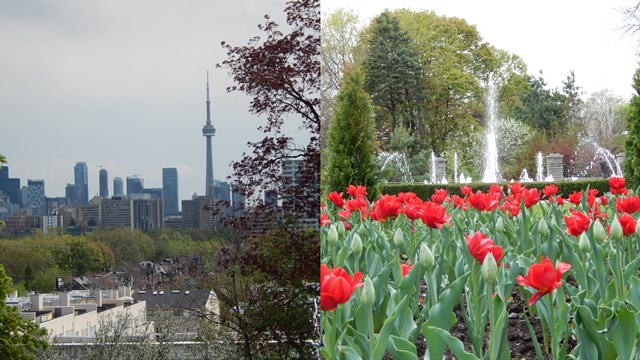
Casa Loma was built in three years, between 1911 and 1914, by 300 workers and incurred a total cost of 3.5 million dollars. It was strategically located, on a hill, to gain a complete aerial view of downtown Toronto. Surrounding the castle are well-tended gardens spanning five acres and fountains that make for interesting photo ops. I read that the Casa Loma gardens won the Phoenix award from the Society of American Travel Writers.
Garden

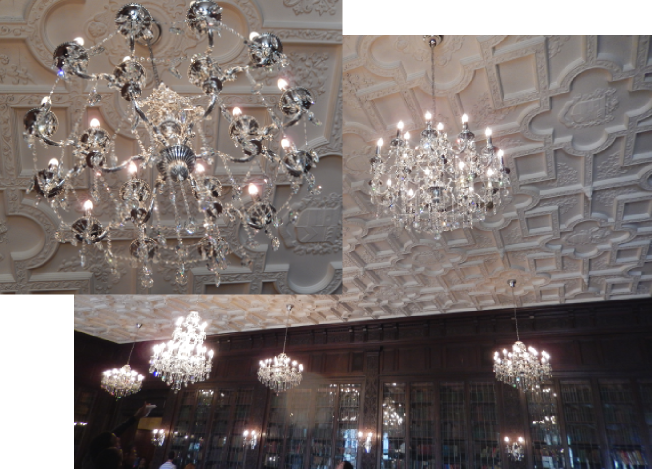
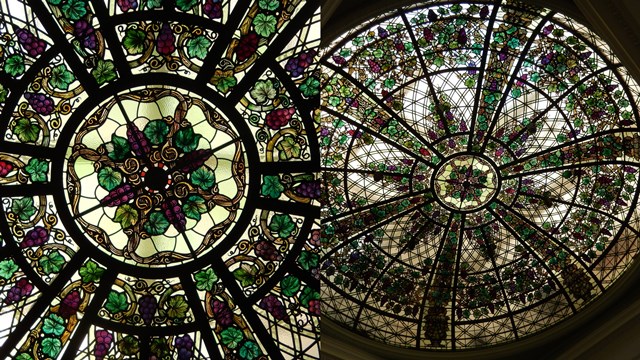
My favorite room, in the castle, is the library with its crystal chandeliers and the continuous array of wooden bookshelves lined up floor-to-ceiling, covering an entire wall. The conservatory has a mesmerizing glass dome roof adorned by stained glass paintings; so were the windows that spread across the room, making it the best-lit room in the house.
ceiling-chendelier

Roof

The exciting part came up when we took a walk along a long winding dark underground tunnel that led us to the garage and the horse stable. The stable, once upon a time, was home to six gorgeous stallions. Each stall had the name of the horse carved in it and looked royal. The garage displayed refurbished vintage cars, which seemed fabulous to wheelcrazy me.

Tunnel

antique-cars

Some of the rooms, on the upper floors, are converted into war museums in order to treasure the artifacts from World War I and II.

Artifact

We saw some interesting signs along certain articles like the below.

Photo 5-18-2014, 15 45 52

These days, the library and the conservatory are used as wedding venues. In fact, just as we were leaving, we saw the staff getting the place ready for such a function and for a fleeting moment, we thought of lingering back and crashing the party!

27 May 2014

Toronto’s Artsy District

If you are a first-time visitor to Toronto, you would have certainly got the suggestion to visit the Distillery District, considered a ‘happening place in town’! It is a fashionable area that is also a heritage site. Having cultural leanings, the Distillery District houses a slew of art and craft shops. It is also an entertainment hotspot with many restaurants and cafes to complement the ambience.

DSCN0201

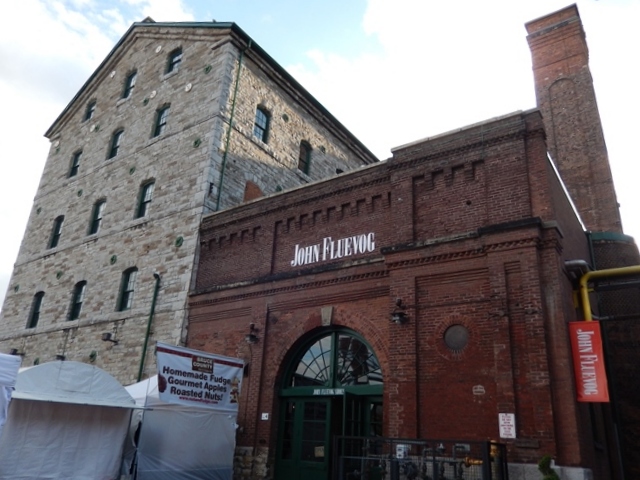
Located in downtown Toronto, near Harbourfront, the Distillery District is listed under the National Historic Sites of Canada. Originally, it was the Gooderham and Worts Distillery, which was founded in 1832 and which closed down in 1990. Since then, the area was preserved as it contained one of the rarest assortments of Victorian buildings and heritage architecture.

DSCN0203

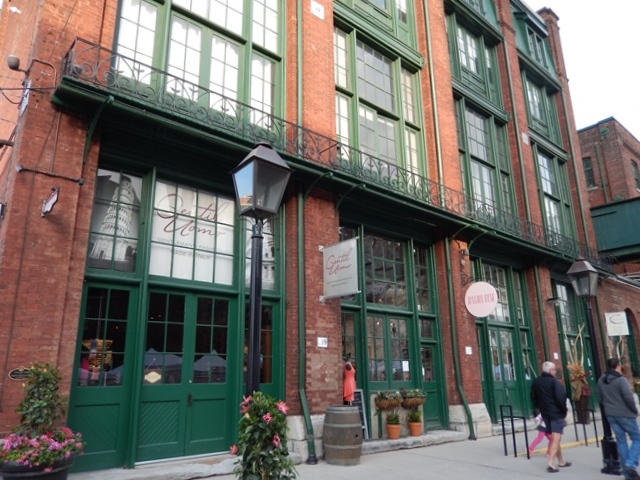
Later, the place was redeveloped into a classy and arty hub. This was done with the intention of keeping away the commercialization prevalent in the surrounding areas. This change proved transformational and the end result is now clearly visible in the district’s designer boutiques, design studios, art galleries, and high-end cafes. Once in, you are mesmerized by the magic of the red brick buildings adorned by green doors and windows. On googling, I found that the shade of green was called British racing green, a phrase originating from the international motor racing colour of the United Kingdom.

DSCN0208

DSCN0218

The hi-storied stone buildings have an aesthetic appeal. Spread over 13 acres, there are around 40 buildings and 10 streets. A short clock tower marks the center of the district. The last time I was there, people had put up tents to showcase their artwork, which was part of an art exhibition that was going on, along the main Trinity Street.

DSCN0226

Sadly, we couldn’t take pictures of the articles inside any of the art boutiques or you would have wondered at the display of everyday objects turned into the most unique items, brimming with creativity. Inside the district were designer furniture shops, clothes boutiques, candle stores, jewellery stores, and also event management companies and performing art schools.

Collage

The place offers a variety of fine dining restaurants serving different cuisines such as Italian, Mexican, seafood, etc. A cocktail lounge and a bar and a grill restaurant completed this selection. We dined at a Mexican restaurant, Elcatrin Destileria, that was playing loud music while the waiters donned painted faces and looked scary. Apparently, it was for an event scheduled for the night. Wonder how many guests turned up!

IMG_8787

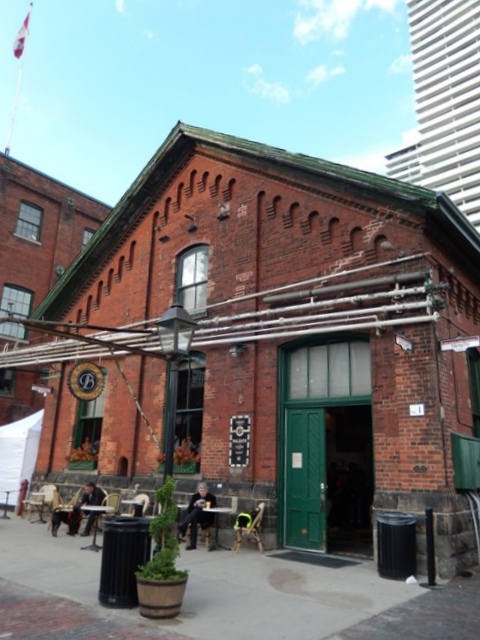
We also saw many people stroll around the vicinity with a coffee in hand from the rustic-looking Balzac’s Coffee Roasters.

DSCN0220

We decided that we would go to the Mill Street brew pub next time, a microbrewery situated there. I also noticed a new construction, a theatre named the Young Centre for the Performing Arts where, I read, that the Soulpepper Theatre Company performed their plays.

IMG_8789

Exploring the distillery district was certainly a worthwhile experience, something I am glad I did!

DSCN0216

20 May 2014

Climbing the Great Wall of China

I have not met many people who have had the opportunity to climb the Great Wall of China twice. So, I consider it no small privilege that I could. After all, it is one of the Seven Wonders of the World and protected as a UNESCO World Heritage Site. I got the opportunity to attempt this feat when I was in Beijing on an official trip.

DSC00246

The Great Wall of China, known as the Long Wall of Ten Thousand Li in Mandarin, was built between the third century BC and the 17th century AD along the northern border of the country, from Shanhaiguan in the Hebei province in the east to Jiayuguan in the Gansu province in the west. The estimated length of the Wall is 21,196 km (13,171 mi). Several rulers from different dynasties governing different parts of China, constructed varied sections of the Wall to fortify their empires against foreign invaders. This ultimately came to be known as the Great Wall of China.

DSC00243

The Great Wall is like a long winding stone trail snaking through the mountains. Two sections of the wall, nearest to Beijing, were open to the public: Badaling and Mutianyu. Located half an hour from Beijing city, the Badaling Great Wall is the most frequented and the time I went there, it was crowded owing to the tourist season, I presumed. It was certainly a stretch, ascending that steep incline with people pushing and shoving you. Yeah, it was that busy! I had taken a conducted tour which also included stopping at a tea house for some indigenous green tea.

DSC00271

Across the wall, watch towers and small fortresses are built, which were used by the army in olden times. Now, they serve as rest areas for the wearied. The highest point is 1,015 metres (3,330 ft) above sea level. If you happen to stop to catch your breath, you will find plenty of street food vendors, perched on railings, ready to quench your appetite. Many hotels and restaurants are also nestled in the foothills.

Our tour guide mentioned that whoever reached the top of the section would be honored as a ‘hero’ as it was a struggle to get there. Unfortunately, I did not make it since I gave up in the middle. The fleeting thought of using the newly-constructed cable car that takes you directly up the hill, did cross my mind. But it seemed like cowardice. I had already vowed to myself that I will complete the climb someday!

Climbing the Mutianyu Great Wall was more comfortable as the slope was easier to walk on. This was again an arranged tour with a guide. With just another visitor in addition to me, we had quite an interesting personal experience.

DSC00241

mutyanyu

A private cab picked us up, took us around and dropped us back at our homes. This part of the Wall, being further away from Beijing, there were also not many tourists around. Mutianyu is perceived as the most beautiful part, with scenic landscapes spread across the countryside. It looked more natural than the Badaling Great Wall which seemed like a commercial tourist hotspot. It is also older than Badaling. The wall at this point is made of granite and is 7–8.5 metres high and 4–5 metres wide. Had a fun time walking around at Mutianyu.

DSC00240

13 May 2014

Back to downtown for a lunch time walk…

Soon after I had moved to the mid-town office (The salt mine I work at has offices all over the world!), I had taken a happy break from winter, going to work from our Bangalore office. So it had been a while since I was in downtown New York. Okay, five months, but this is New York and a lot can happen in five months! And recently when I went to meet a few friends there, it was like a new place… all exciting and interesting! And of course, I went on a lunch time walk. So this is for all my friends who used to share that walk in times gone by…
 
path-tunnel

The first noticeable change was the new connection to the Winter Garden from the World Trade Center PATH station. Gone is the bridge and corridor overlooking the construction site at WTC. The high ceilinged concourse is stunning, with the pillars arching over, way above the pedestrians. Designed by Santiago Calatrava, the concourse is part of the transportation center at the WTC, scheduled to open in 2015. The concourse will have shops lining the sides when whole construction is complete.
 
winter-garden

The Winter Garden is also being redone, of course, without changing the iconic basic structure.
 
trees-winter-garden

The trees outside the winter garden always reminded me of candelabras in their winter state. And in the next week or so, those branches will be adorned with green leaf clusters, obscuring the structure of the branches, but providing such delightful shade to people taking their lunch break under them.
 
tree-with-buds

The trees have already started sprouting buds, even as last year’s dry seeds are still hanging on.
Squirrels are already busy starting their collection for the next winter. Come on buddies, don’t worry… winter is sooo far away!
 
squirrel1

It is a wonderful walk along the tree lined walkway to the battery Park, with river Hudson on one side.
 
battery-walk2

I love the blue lights along the South Cove where one can climb up on the viewing towers to get a good look at the Hudson traffic and the Statue of Liberty.
 
blue-lights

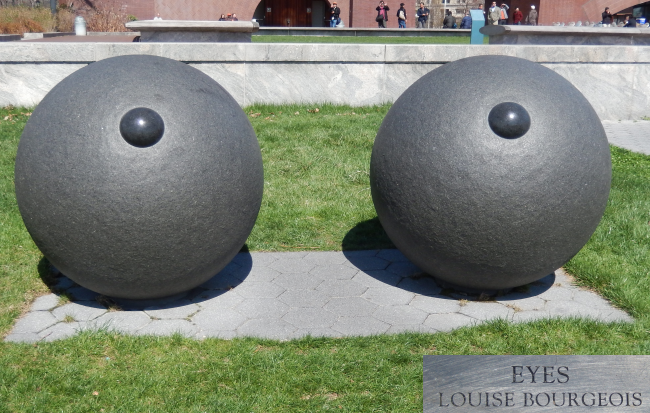
And there are interesting art works as you continue past the South Cove. One of the art works always aroused speculation among us though its name was clearly written. I have seen people looking at it from all angles to see what the artist wanted them to see, instead of what a first look told them. Here is the artwork for you…
 
eyes

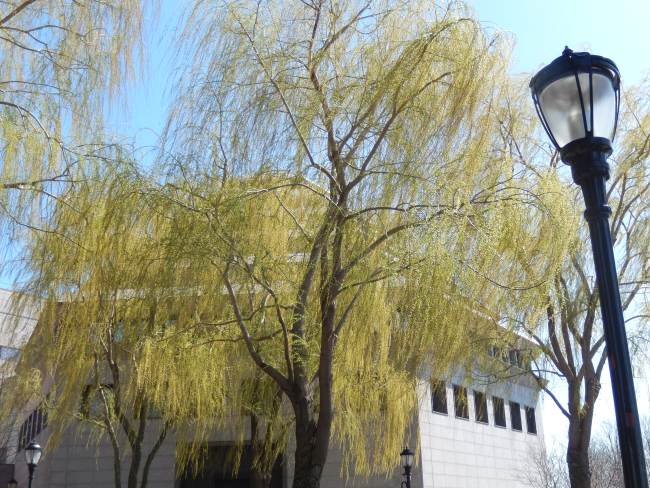
There is one willow tree that I take note every year; it is one of the first to sprout and it is ever beautiful with its delicate tresses waving in the breeze from the river.
 
weeping-willow

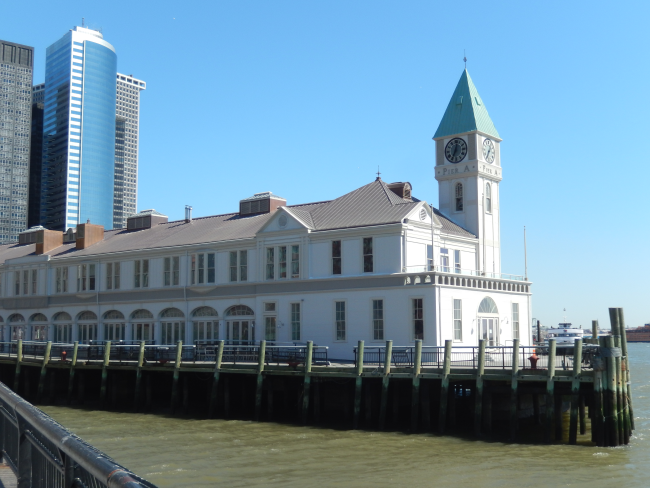
At the corner of Battery Park is Pier A, originally constructed in 1886 and in use variously by the New York City Department of Docks and Harbor Police till 1992. It is the oldest historic pier in the city and is a designated New York City Landmark. Currently, it is being restored and will be home to an oyster bar and restaurant.
 
pier-A

Charming is the apt word to describe the Manhattan skyline from this point. The red stones of the old buildings and the blue reflection on the new 1 World Trade Center tower look so well matched.
 
skyline-with-tower

From the Battery Park, I turn to Broadway and the walk back. Of course, saying Hi to the Wall Street bull.
 
wall-street-bull

The history of that bull and how it came to be in that spot is a story connected to the illustrious past of this financial capital of the world. Another time…
 

~Ria

09 May 2014

A Toast to Ontario’s Crowning Glory

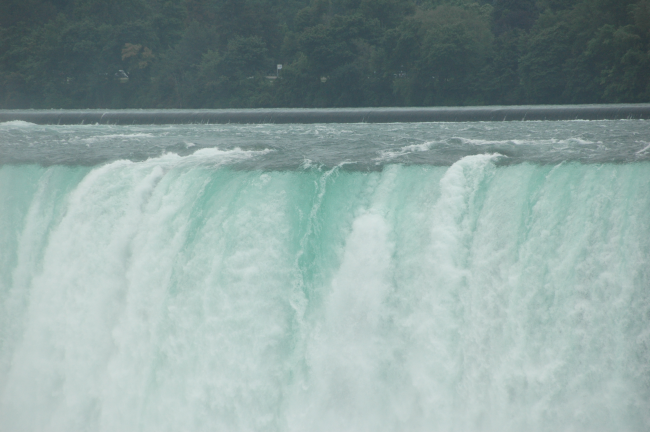
It’s very common that many of my friends envy me my home close to the Canadian side of the famous Niagara Falls. After all, it is the most well-known of the waterfalls with the maximum number of visitors and also the largest in North America. It is indeed an amazing sight to look at the gigantic sheet of water thundering down and splashing on the rocks below, often creating multiple rainbows.

water-closeup

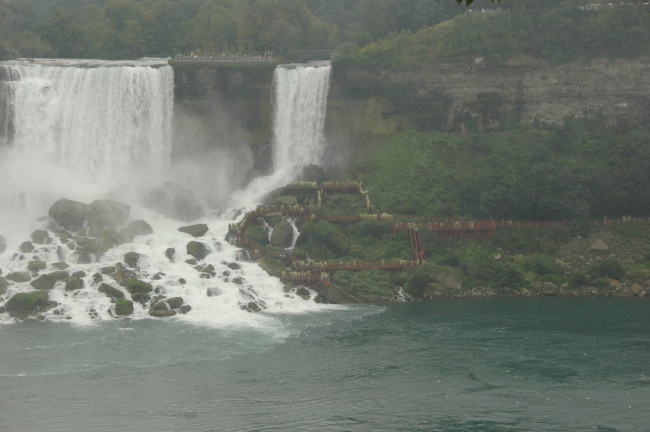
Located on the US-Canadian border, on the Niagara River, there are three waterfalls that make up Niagara Falls, namely the Horseshoe Falls, the American Falls, and the Bridal Veil Falls. Among these three, it is the Horseshoe Falls that takes the spotlight with a width of 2,600 feet (790 m) and a height of 173 feet (53 m).
Niagara Falls came into being 10,000 years ago when the ice melted after the Wisconsin glaciation and the water from the Great Lakes made its way through the Niagara River to the Atlantic Ocean, forming Niagara Falls on the way. Gradual erosion over the years has given the Falls its current shape. Geologists predict that, at this rate of erosion, the Falls will be nonexistent in 50,000 years.

america-bridal-veil

American Falls and Bridal Veil Falls

Compare the height of the people to get an idea of the size of the waterfall!

horse-shoe-falls

Horseshoe Falls

The name, Niagara, comes from the name of the local people who used to reside in the area. Niagara Falls happens to be a hop, skip and jump away from my home city… one of the reasons for having seen the Falls in every season, may it be spring, summer, fall, or winter. And I must admit, it is the fall season I like the best when the trees are in brilliant colors, the gardens are well-tended, and the beautiful scenery extends beyond the magnanimous flow of water to the fall colors, the orangish-red foliage of the trees and the iridescent floral gardens.
In the winter ice storm of 2013, Niagara Falls looked picturesque as a huge ice sculpture. It was subfreezing temperatures most of the time though fun to hang out.

winter-falls

The Maid of the Mist boat ride is a summer event that takes you to the base of the Falls where you are drenched by the mist from the Falls. A thrilling experience, worth a try.

Niagara Falls has been a venue for many publicity stunts. In 2012, Nik Wallenda, a tightrope artist, walked across Niagara Falls on a wire strung from the American side to the Canadian side. That was a major show for the public, broadcast live on national television as well as a great achievement for him.

falls-winter

In earlier years, there have been people who have rolled over the Falls or jumped over. In 1901, Annie Edson Taylor survived the experience of rolling over the Falls in a barrel. Sam Patch was the first person to jump over the Falls. Some of these daredevil stunts were staged to garner money.

niagara-on-the-lake

Along the falls lies a commercial town filled with casinos, posh hotels and restaurants, observation towers, souvenir shops, amusement parks, game shops, neon billboards, and advertisements.

vinery

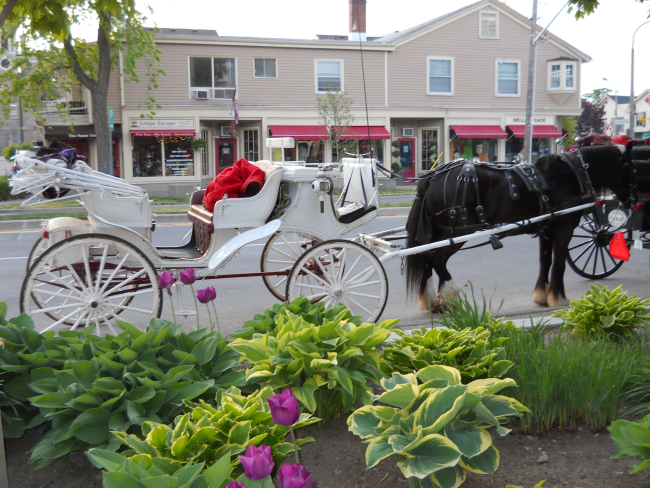
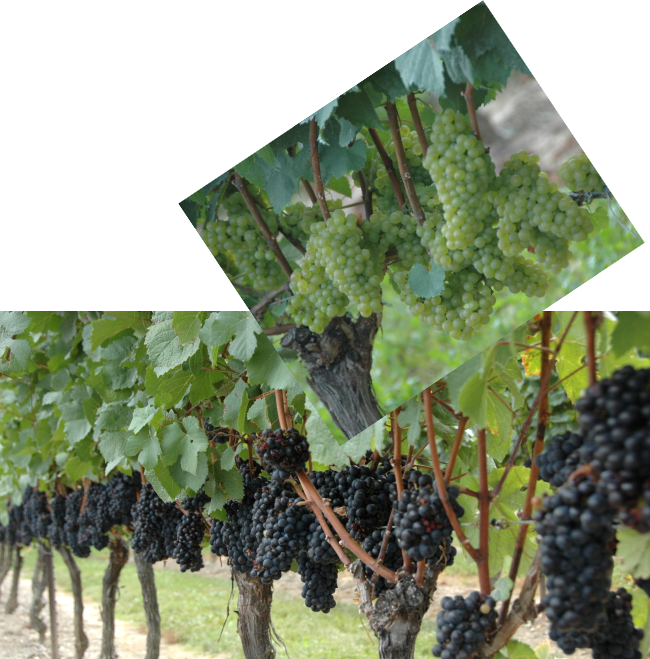
Surrounding this area is the wine country and the provincial town of Niagara-on-the-Lake. It is this town that I always look forward to while visiting Niagara Falls. Not only do I get to taste different kinds of wine from the nearby vineries but also for its quiet splendour and relaxing environment.

grapes

~Cux

15 Apr 2014