Making it from Scratch – Candied Peels

candied peel 2


I always prefer using home-made ingredients in cooking, if possible, to buying them from shops. I can vouch for the quality of the spice mixes I make for various dishes. Now coming to our subject “candied peel” which literally means making candy out of peels.


candied Peel 1


Candied peels can be made using peels of citrus fruits like lemon, orange, grapefruit etc. Candied peels are generally used in cakes, puddings and can enhance a cocktail as well. You can also munch on them whenever you feel like.

The first time I tried to make candied peel was when I needed some for a cake and I was in a location where I couldn’t get out and buy some. I used oranges and it was a success. Since then, I have never bought candied peels. It’s a good way of making use of the peels as well. The general principle of the process is to boil the peels in strong sugar syrup and then dry off any moisture left.


candied peel 3


Make sure firm oranges are selected for this, otherwise peeling the skin off the fruit becomes messy. Use a sharp tipped knife to core the skin into segments and then peel off. Remove the pith as much as possible to reduce the bitterness. Cut them into ½ cm strips before boiling in water.


candied peel 4


The bitterness is further removed by boiling the peels in water before candying. Boiling the peel not only makes it soft and porous (to absorb more sugar) but also removes any pesticide residue.


candied peel 5


Sugar syrup made for this purpose is a sugar to water ratio of 2:1. Once the peel strips are boiled and removed from the syrup and left to dry on a wire rack, the remaining sugar syrup can be used for making cocktails or to moisten cakes before icing them.


candied peel 6


My candied peels were dried overnight and ready to use the next day.

~Min

divider-recipe

Ingredients

Orange Peel – 2 oranges

Granulated sugar – 2 cups

Water – 1 cup

Granulated sugar – ¼ cup

Directions

  1. Peel the skin off oranges, remove the pith and cut into ½ cm strips.
  2. Add this to a pan of water and heat till the water is boiled. Drain.
  3. Repeat step 2 once more.
  4. Add the drained orange peels into pan with one cup of water and add sugar. Heat the mixture till it starts boiling.
  5. Once boiled reduce heat and let it simmer for 30 minutes.
  6. Remove the peels using a slotted spoon into a bowl, sprinkle sugar and spread them on a wire rack to dry completely.


recipe-divider

29 Jan 2014

What is in a name? Seriously?

I am a great fan of AWAD (A.Word.A.Day), a daily subscription email list founded by Anu Garg of wordsmith.org. There are certain words that I might not have ever encountered but for the daily AWAD email. Petrichor jumps to mind… that lovely indescribable scent that emanates from the parched earth after the first rains, finally got a name when it dropped into my inbox one fine morning. Bringing with it, memories of monsoons and school reopenings which for some inexplicable reason coincided most of the time. But I digress…

place-names-word-cloud2

Last week’s AWAD theme was toponyms – words derived from the names of places. Got me thinking about how place names came into being. Also, about interesting place names.

It is easy to imagine the need to identify geographical locations in communications, even in cave people days. ‘Big mammoth felled at rock mountain; come, join the fun’ would prevent a lot of that mammoth going waste, you can imagine. 🙂 And most of the earliest place names were based on geographical features, naturally. That trend continues to the present day with innumerable names like Glendale, Riverside, Hillview, etc.

A lot of place names were carried over from the old countries by immigrants who were nostalgic for the lands left behind. New York (earlier, New Amsterdam, when it was owned by the Dutch), Lancaster, Brunswick (New, North, South), Rochester, Stamford, Berlin, Copenhagen… they are all present. When I was travelling in Egypt, the tour guide asked us why we had to have a Cairo and Alexandria in the US. The only answer we could give was that the US is a true melting pot! 🙂

place-names-word-cloud1

Many of the current place names are derived from their original names used by the native Americans, which again were based on geographical features. A prime example is Manhattan, from ‘manna-hata’ meaning ‘island of many hills’ in the language of the Lenape tribe. Massachusetts (by the great hills), Connecticut (place of the long river), Hoboken (where pipes are traded), Passaic (river flowing through a valley)… very interesting to take a look into the thousands of such names.

Then there are place names that exist in every state, sometimes more than once in the same state. Middletown, Harrison, Bloomfield, Fairfield… can you think of any state that does not have towns with these names?

Then there are the truly interesting place names. Like Cut and Shoot in Texas, Casa Blanca and Moriarty in New Mexico, Hell in Michigan, Real and Loving also in Texas (two towns, not Real Loving!), Caliente (meaning ‘hot’ in Spanish) and Steamboat in Nevada… the list goes on. Not to forget Blue Ball and Intercourse in Pennsylvania, so inexplicably close together!

But my favourite is Truth or Consequences in New Mexico. According to my friend Google, the city called Hot Springs changed its name to Truth or Consequences, the title of a popular NBC radio program, in 1950, in response to a promise that the program will be aired from the first town that renamed itself after the show. Voila! Hot Springs got a new name!

The most poetic and literary place names I have come across belong to Columbia, Maryland. Columbia is a planned community with self-contained villages and its localities are named after places in the literary works of well-known American authors like Hemingway, Scott Fitzgerald, Walt Whitman, etc.place-names-word-cloud10

Kind Rain, Scarlet Petal, Rising Moon, Deep Calm, Open Sky, Tawney Bloom… can you imagine any more poetic place names?

Divider2-LR-4px

Interesting thought…

According to Wikipedia though the word Manhattan has been translated as ‘island of many hills’ from the Lenape language, the Encyclopedia of New York City offers other derivations, including from the Munsee dialect of Lenape: manahachtanienk (‘place of general inebriation’), manahatouh (‘place where timber is procured for bows and arrows’), or menatay (‘island’). Which one would you think is most apt? 🙂

Divider2-LR-4px

27 Jan 2014

Birds Galore!

Kibimba is a unique location in Uganda for its fantastic bird life.

[cycloneslider id=”293″]


Birds Galore @ Kibimba Rice Farm……

The national bird of Uganda.

The national bird of Uganda

I‘ve been visiting and spending a considerable amount of time at various times of the year at a rice farm in Eastern Uganda. To be more precise this fully mechanised rice farm is in Kibimba and covers an area that is 13 kilometres long and 3.5 kilometres wide. I’ve been a visitor of this farm since the year 2000 and I have always enjoyed all aspects of farm life especially the drives along the fields and the morning walks. Walks in the evenings are far less enjoyable unless you set out early enough as the insects that appear after sunset are a real menace.

Yellow Billed Storks

Yellow Billed Storks

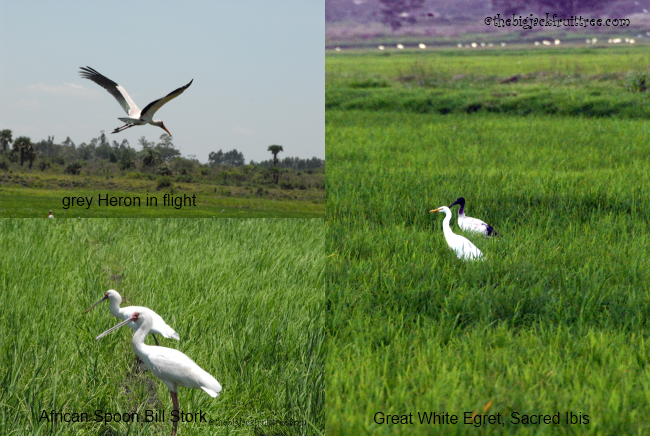
During our morning walks and drives along the fields I come across many birds (especially water birds) and these are constantly identified by my companions. I always try to identify these birds by name, but to my dismay I am never very successful. This Christmas, when I was taking a guest around the fields I was appalled that I couldn’t name even an egret or an ibis correctly. The only ones I could name were whistling ducks!

Birds galore composite

Then the realisation dawned on me that it’s high time I take some interest  in the birdlife of Kibimba. Kibimba has the IBA (Important Bird Area) status and it’s a unique location for its birdlife.

Great White Egrets in the company of Storks

Great White Egrets in the company of Storks

So I decided to look up the birds I see regularly when I go for my walks in the early mornings and find out a little bit more about them. The discussions with the staff of Kibimba Rice Farm and Collins Book of Birds were my source. This exercise also helped me in identifying many birds this time when we were at Murchison Falls National Park.

Grey Herons

Grey Herons

So watch this space to know about birdlife at Kibimba.

                                                                                                                                                            ~Min


24 Jan 2014

Waiting for the third…

AGhosh-featureWe do a lot of waiting in life… waiting for trains, waiting in lines at stores to pay money, waiting for the water to boil… all painful. But there are some waitings that are enjoyable. Full of anticipation. Like waiting for a friend to call. Or for spring to arrive. However, even such waitings are hard for me… have zero faith in the saying ‘Patience is a great virtue’. Rather agree with Ambrose Bierce whose saying goes, ‘Patience, n. A minor form of dispair, disguised as a virtue’. 😉

But I digress… At present I’m in such a state of impatient waiting. Waiting for the third and last book in the Ibis trilogy, by one of my favourite authors, Amitav Ghosh, to be published.

trilogy

The first book in the trilogy, Sea of Poppies was published in 2008, followed by River of Smoke in 2011. In a nutshell, the books tell the story of the trade of opium in the early 19th century and the people whose lives, knowingly or otherwise, get entangled in its web.

The author paints the stories of individuals in vibrant colours in the background of the trade in opium, the cultivation of which was forced on the farmers of northern India and the consumption of which was forced on the population of another country, China, against the objections of their government. The snippets of history remembered from school days – the opium wars and the carving of the Chinese melon – come alive in the lives of these characters.

SoP

Sea of Poppies narrates the journey of the ship Ibis which carries opium from India to the markets of China, along with a group of passengers very unlikely to have met in any other surroundings. The intricate threads that bind these passengers to each other and to the central theme explain the circumstances which bring them to the good ship Ibis. And the drama of that voyage and the fortuitous turn of events bring the book to a satisfying end.

In River of Smoke, we follow the passengers on Ibis to their different destinations, some to new lands and new fortunes; others to age old conflicts and tensions. The characters are so nuanced that you will be hard put to root for any one side. While the conflicts of life throw them against each other, you as the reader recognises their innate humanness and can’t do anything other than sympathise with them.
RoS

If you are one to let your imagination soar like a kite braced by the breeze of words on a printed page, you will love these books and the rich and vivid tapestry of life they weave. And you will understand why I’m so impatient to get my hands on the concluding part of this trilogy. If we go by the timeline of the previous releases, the third part should be out in 2014. Waiting, waiting…
 

HT

And to console myself in the interim, I have chosen Hungry Tide as my vacation reading. I have already read Shadow Lines and Circle of Reason, around when they were first published. 20 years ago? How time flies when you are having fun! 😉

You can read more about the Ibis trilogy and other books by Amitav Ghosh at his web site.

~Ria

22 Jan 2014

Pineapple Upside Down Cake

Ugandan Pineapples are the best….

[cycloneslider id=”ugandan-pineapples”]

This time when I put my baker’s hat on, pineapple upside down cake – the glistening, sticky sweet top of pineapple slices on top of a simple white cake, came into my vision. This sweet top lifts the simple white cake up a notch.

PUDC 1


In the US, pineapple upside down cakes became popular in the 1920s when canned pineapples were easily available for reasonable prices while fresh ones were difficult to find  and if they were available, they were very expensive. The widespread availability of canned pineapples owes to Jim Dole of Hawaiian Pineapple Company who canned a major chunk of pineapples available. Traditionally pineapple upside down cakes were made in cast iron skillets on top of the stove.


PUDC 2


When you bake a pineapple upside down cake in Kampala, it’s criminal to use canned pineapple since pineapples grow in plenty in Uganda and are currently in season. Not only the quantity but the quality  is also topnotch. The pineapples are sweet, succulent and big. The skin/crust of Ugandan pineapples are hard and hence has a longer shelf life. Read what Ms. Salima Njeri, a Kenyan trader says about Ugandan pineapples. 


PUDC 3


As I was little apprehensive about using  fresh slices of pineapple instead of canned as it can make the batter watery. So I tried my hand at canning the pineapple slices which I did the day before baking.Peace, my house help helped me in peeling and slicing the pineapple. If you are not skilled at peeling whole pineapple, I suggest cutting it into rings after cutting the crown and stem off. And then cut the skin off holding each slice . The core can then be removed using a cookie cutter or any sharp cylinder of right size.

Sugar syrup is made using sugar and water in a ratio of 1:2 as these pineapples are really sweet and will be used up in a day. If the slices have to be kept for long use a syrup of 1:1 ratio.


PUDC 4


For any upside down cake the fruit and brownsugar are placed on the bottom of the pan before batter is poured in. But here caramelised sugar is used instead of brown sugar. Oil and yoghurt are used instead of butter in my cake recipe.


PUDC 5


In pineapple upside down cakes a glazed cherry each is placed in the middle of each slice where the core of the pineapple was. Since there were no cherries in stock in my pantry I’ve decided to bake mine without it as cherries wouldn’t add on in any way to the taste of the cake. But later once the cake was turned upside down,I realised that it was not very appealing to look at.


PUDC 6


Voila! here’s the final product. Red Plum jam came to my rescue.

Min

divider-recipe

Ingredients

For Canning ( read Cooking J ) the fresh pineapple slices

Sugar – 1 cup

Water – 2

Orange peel – 1-2 pieces (optional)

For the base

Granulated sugar – ¼ cup

Water -1 tablespoon

Pineapple rings – 6

For the cake

All purpose flour – 2 cups

Baking powder – 1 ¼ teaspoons

Baking soda – ½ teaspoon

Granulated sugar – 1 ¼ cup ( can change it according to the sweetness    – of the sugar available)

Vegetable oil – 2/3 cup

Yoghurt  – 1 ¼ cup

Eggs (large) – 2

Vanilla essence – 1 teaspoon

Syrup from the cooked pineapple – ¼ cup

Cooked pineapple (minced) – ½ cup

Method

  • Skin the pineapple, cut into 1 cm thick slices and remove the centre core.
  • Heat sugar and water ( add orange skin as well if it’s used ) together till it starts simmering.
  • Transfer the prepared slices into the syrup and keep it in a waterbath and cook for 45 minutes with a lid on.
  • Remove from the waterbath and cool. Cooking of the pineapples can be done in advance.
  • Prepare a 10 inch / 25 cm tin by buttering the base and the sides. But flour only the sides.
  • Heat the sugar for the base till it caramelises.
  • Add 1 tablespoon warm water and heat it again to get pourable consistency without any solid bits.
  • Pour into the prepared tin and spread it on the base of the tin by tilting it.
  • Arrange the pineapple slices in a circular manner with one in the middle.
  • Sift the flour, baking powder and baking soda together twice.
  • Beat sugar, oil and yoghurt together till till creamy and mixed well.
  • Add eggs one at a time and beat well.
  • Now add one third sifted flour, mix well.
  • Add half of the syrup, followed by half of the remaining flour. Beat till the flour is just mixed.
  • Add the remaining syrup and flour and mix again.
  • Once all the flour is incorporated mix the batter well for 4 minutes using a wooden spoon. If an electric hand mixer is used, attach the whipping attachment and beat for 3 minutes in medium speed.
  • Transfer the batter to the prepared tin and bake for 35 minutes or until a wooden skewer inserted in the centre comes out clean.

 recipe-divider

20 Jan 2014