Tag Archives: Manhattan

D is for Drawing

The Drawing Center

Located at 35 Wooster St., New York, NY, 10013
Website:  https://drawingcenter.org/

If you are interested in the art of drawing even a little bit, and you are in New York for a day, this is the place you want to be. A visit to the Drawing Center is such a wonderful experience you are sure to return for more. 

The Drawing Center is a museum and exhibition space in downtown Manhattan. Founded in 1977, with the aim of exhibiting art by living artists in their own neighborhood, as well as to advance the medium of drawing. To quote from its website, The Drawing Center “explores the medium of drawing as primary, dynamic, and relevant to contemporary culture, the future of art, and creative thought.”

The Drawing Center was founded by Martha Beck, a former curator of contemporary art in the Department of Drawings at the Museum of Modern Art (MoMA). 

Since its opening, The Drawing Center has held exhibitions of works by established as well as emerging artists. Over the years, it has managed to expand the definition of what a drawing is, and what it can be. The artists whose extraordinary drawings have been part of the exhibitions include tattoo artists, chefs, novelists, soldiers, prisoners, all those who define themselves as visual artists.

The Drawing Center organizes in-person and online drawing workshops in multiple languages including ASL.

It holds many programs for students from across the five boroughs, to provide them with an in-depth visual art experience focused on the medium of drawing.

The bookstore dedicated to everything drawing has rare publications featuring legendary artists and past exhibitions. 

The Drawing Center provides on its website downloadable and printable material for drawing activities, designed for all ages, to help teachers.

To raise funds to support its exhibitions, publications, public programs, and education initiatives, The Drawing Center holds an annual gala., which this year falls on May 3, 2023.

When I last visited in October 2022, the three exhibitions going on were as diverse as could be.

Drawings created by Jorge Zontal, a member of the General Idea collective based out of Toronto, Canada. Zontal basically uses a certain figure or motif repeatedly to drive home an idea. 

The drawings were grouped thematically in the main gallery to provide visual testament to the drawings’ obsessive nature and to General Idea’s propulsive creative tendency. The drawings were for the most part untitled.

Pen and ink drawings by El-Salahi, one of the most significant artists in African and Arab modernism. 

Featuring over a hundred drawings from El-Salahi’s latest series, titled Pain Relief, this exhibition marked the first museum presentation of the artist’s drawings since his 2013 retrospective at Tate Modern.

Drafted on the back of medicine packets, pill bottle labels, envelopes, and scraps of paper, El-Salahi’s Pain Relief drawings serve as a form of respite for the 92-year-old artist, who finds diversion from his chronic pain through his daily drawing practice. 

I could spend hours looking at these drawings; they are so intricate and so full of minute details that one can never finish looking at them.

We Rule – an installation by New York-based artist Catherine Chalmers, inspired by her observation of and engagement with more than one dozen colonies of Leafcutter Ants on the Osa Peninsula in Costa Rica. For the artist, Leafcutter Ants can be seen as a metaphor for humanity’s life on earth: they farm, communicate, and collaborate; they also colonize, battle, and destroy. Yet the drawings in We Rule highlights a significant way that the insects diverge from humans – as an integrated part of their ecosystem, the ants carry out their actions in harmony with the earth.

Current Exhibitions (Through May 14, 2023)

Xiyadie: Queer Cut Utopias

Queer Cut Utopias features Chinese artist Xiyadie’s intricate paper-cuts, dating from the early 1980s through today. Xiyadie’s singular artistic language originated in the more traditional techniques of paper-cutting, and his expertise allows the artist to develop intricate compositions.

Of Mythic Worlds: Works from the Distant Past through the Present

Exploring the ways in which rituals, myths, traditions, ideologies, and beliefs can intersect across cultures, histories, and time periods, the exhibition brings together fifty-three works by more than thirty artists.

05 Apr 2023

C is for Castle

Castle Clinton National Monument

Located at 26 Wall St, New York, NY 10005
Monument Website:  https://www.nps.gov/cacl/index.htm

A fort built on the rocks off the shore of the southern tip of Manhattan to protect the city from attacks by the British, an entertainment center where celebrities performed, an immigrant processing center, an aquarium, and now the ticket office for the Statue of Liberty… Castle Clinton National Monument has gone through many phases in its lifetime. 

In the early years of the 19th century, tensions were growing between the United Kingdom the United States.

In anticipation of a possible war, it was decided to build five new forts to protect the New York harbor, along the coastline. Castle Clinton at The Battery, then called the South West Battery, was one among those. (Three of those early forts Castle Clinton, Castle Williams on Governors Island, and Fort Wadsworth on Staten Island are still standing today.)

The circular sandstone fort was armed with 28 cannons pointed at the open sea and any approaching ships. It was connected to the mainland by a wooden bridge. Construction of the Battery was completed in 1811. 

In 1812 US declared war on the United Kingdom. During the war that lasted till 1815, New York harbor was not attacked and the cannons at the Battery did not have to be fired. 

The South West Battery was renamed Castle Clinton in 1815 in honor of DeWitt Clinton, Governor of New York and one time mayor of New York City.

The fort was decommissioned as a military base in 1823 and in 1824 leased by the City of New York as a place of public entertainment and renamed Castle Garden. 

As an entertainment center and concert hall, Castle Garden was a great success. Celebrities and US presidents visited. Jenny Lind, known as the Swedish Nightingale came here to perform to a rousing welcome. 

The flow of immigrants to the US increased due to the unrest in Europe and the famine in Ireland. It was necessary to process the multitude of people arriving at the New York shores. New York State identified the Castle Garden as a suitable location for this purpose and it was leased by the state in 1855. The same year, the island on which the Castle Garden stood was connected to the mainland, filling the channel in between. 

Castle Garden was the first immigrant landing depot to be established by the New York State, which functioned as such for the next 35 years. During this period, over 8 million immigrants entered the country through Castle Garden. Noteworthy among them were Nikola Tesla, Harry Houdini and Joseph Pulitzer. 

In 1890, the federal government took over the responsibility of managing immigration and built a larger facility on Ellis Island. 

The castle building was renovated and remodeled as New York City Aquarium in 1896. The aquarium became very popular with New Yorkers. However in 1941 it was decided to demolish the aquarium to build the Brooklyn Battery tunnel. The decision is met with strong resistance and protests from historians and preservationists. The demolition is halted in 1942 due to the world war, but by then only the walls of the castle are standing. 

Following the efforts of the preservationists, Castle Clinton is declared a National Monument with an act of the US Congress in 1946. The National Park Service, in 1975, restored the castle to its early military appearance and it is opened to the public as Caste Clinton National Monument. 

Today Castle Clinton houses the ticket office for the Statue of Liberty and Ellis Island. A small exhibition hall, close to the front entrance, has on display amazing photos, some from old books.

04 Apr 2023

Back to downtown for a lunch time walk…

Soon after I had moved to the mid-town office (The salt mine I work at has offices all over the world!), I had taken a happy break from winter, going to work from our Bangalore office. So it had been a while since I was in downtown New York. Okay, five months, but this is New York and a lot can happen in five months! And recently when I went to meet a few friends there, it was like a new place… all exciting and interesting! And of course, I went on a lunch time walk. So this is for all my friends who used to share that walk in times gone by…
 
path-tunnel

The first noticeable change was the new connection to the Winter Garden from the World Trade Center PATH station. Gone is the bridge and corridor overlooking the construction site at WTC. The high ceilinged concourse is stunning, with the pillars arching over, way above the pedestrians. Designed by Santiago Calatrava, the concourse is part of the transportation center at the WTC, scheduled to open in 2015. The concourse will have shops lining the sides when whole construction is complete.
 
winter-garden

The Winter Garden is also being redone, of course, without changing the iconic basic structure.
 
trees-winter-garden

The trees outside the winter garden always reminded me of candelabras in their winter state. And in the next week or so, those branches will be adorned with green leaf clusters, obscuring the structure of the branches, but providing such delightful shade to people taking their lunch break under them.
 
tree-with-buds

The trees have already started sprouting buds, even as last year’s dry seeds are still hanging on.
Squirrels are already busy starting their collection for the next winter. Come on buddies, don’t worry… winter is sooo far away!
 
squirrel1

It is a wonderful walk along the tree lined walkway to the battery Park, with river Hudson on one side.
 
battery-walk2

I love the blue lights along the South Cove where one can climb up on the viewing towers to get a good look at the Hudson traffic and the Statue of Liberty.
 
blue-lights

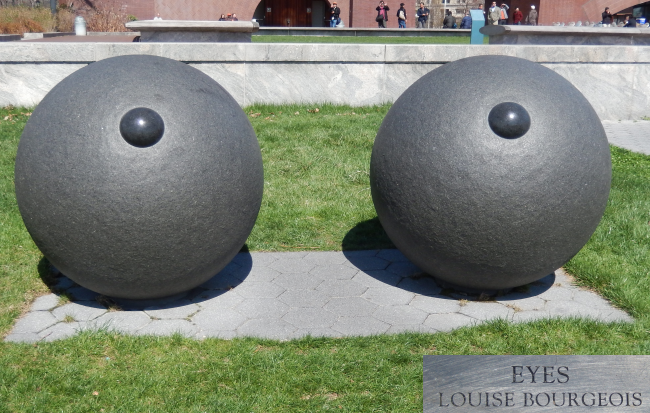
And there are interesting art works as you continue past the South Cove. One of the art works always aroused speculation among us though its name was clearly written. I have seen people looking at it from all angles to see what the artist wanted them to see, instead of what a first look told them. Here is the artwork for you…
 
eyes

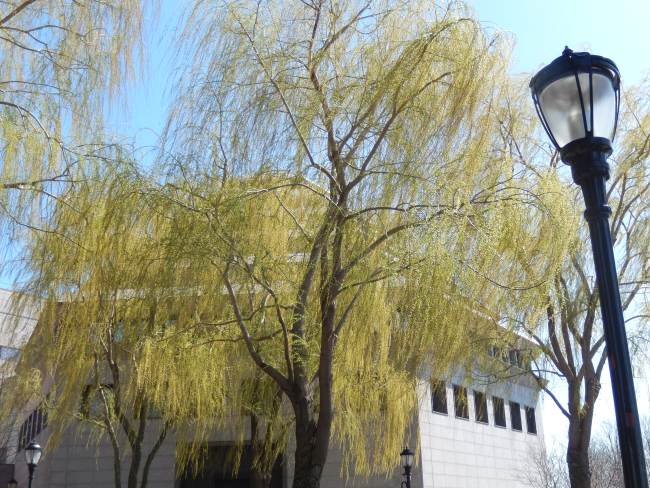
There is one willow tree that I take note every year; it is one of the first to sprout and it is ever beautiful with its delicate tresses waving in the breeze from the river.
 
weeping-willow

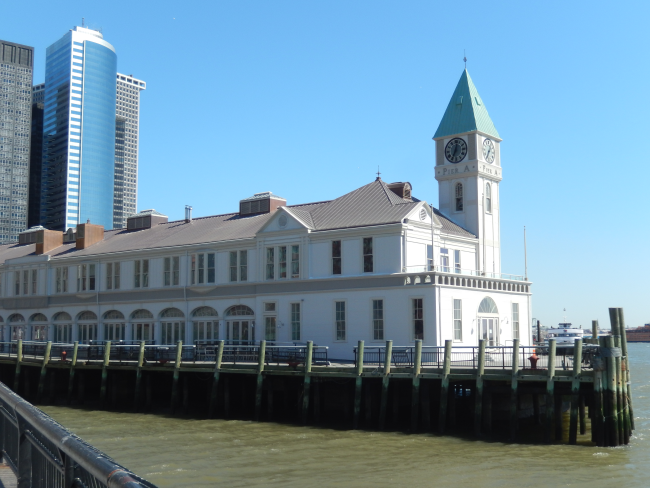
At the corner of Battery Park is Pier A, originally constructed in 1886 and in use variously by the New York City Department of Docks and Harbor Police till 1992. It is the oldest historic pier in the city and is a designated New York City Landmark. Currently, it is being restored and will be home to an oyster bar and restaurant.
 
pier-A

Charming is the apt word to describe the Manhattan skyline from this point. The red stones of the old buildings and the blue reflection on the new 1 World Trade Center tower look so well matched.
 
skyline-with-tower

From the Battery Park, I turn to Broadway and the walk back. Of course, saying Hi to the Wall Street bull.
 
wall-street-bull

The history of that bull and how it came to be in that spot is a story connected to the illustrious past of this financial capital of the world. Another time…
 

~Ria

09 May 2014