Tag Archives: Museums

X is for ‘Xception

Located at 158 Sterling Rd, Toronto ON, Canada A M6R 2B7
Museum Website: https://moca.ca/ 

Museum of Contemporary Art

This is the exception that proves the rule… in other words, this post doesn’t stick with any of the theme rules… it is not in the five boroughs of New York City, it can’t be reached by the New York public transit system, and it is not free! So it is a true ‘Xception!

If there is one thing that is truly a representation of our current cultural moment, that would be art, more specifically our contemporary art, inclusive and interdisciplinary. Such is the base for the Museum of Contemporary Art (MOCA) in Toronto.

MOCA was born in the late 90s to provide Canadian artists an opportunity to manifest their internal voices. This space was created for artists to experiment with multilayered themes, diverse realities and complexities thriving in the cultural microcosm of this globalized city.

With multiple transformations since its inception, MOCA has set up roots in various parts of the city and thus brought a cultural dialogue into those neighborhoods. Initially located at Queen West, MOCA established its presence as a renowned art gallery of Toronto. Later, it moved to the current location, the heritage Auto building, that was designed by architect John W. Woodman of Winnipeg in 1919. This historical building was originally a factory that produced aluminum products for World War II and was known for its innovative architectural construction. In those days, it was the tallest building in the city and pioneering an innovative approach known as concrete flat slab architecture. Each floor is a slab of reinforced concrete and is supported by concrete columns.

During my visit to the museum, I was mesmerized by its external and internal architectural design. 

The museum had large barn doors with a blue metal window protruding out of the front face of building, which is an installation art by Ghazaleh Avarzamani.

There are some woderful exhibitions going on currently.

Kapwani Kiwanga – Remediation

The Canadian-French artist Kapwani Kiwanga`s survey exhibition Remediation showcases the artist’s work around environmental sustainability and conservation in the face of the political and economic turmoil. It delves into the interactions between humankind and nature and how the two while disrupting each other also provide remediation through unique ways of purge and sustenance to maintain ecological balance. 

The main exhibit, Elliptical field, is a site-specific arrangement of steel compositions covered in sisal fiber. This artistic installation is considered a contrast to the industrial space the museum housing in. It emphasizes the coexistence of the natural with the manmade and the duality of the world. 

Another exhibit that I found interesting is the balloon vivariums in different plant shapes that signaled a promising future, in which vivariums will be made to protect and support plant life rather than enclose and cage.

Other site-specific elements include a sculpted drywall with colored windows that give off a sense of blocking the concrete jungle outside to preserve the aesthetics inside. 

Athena Papadopoulos – The New Alphabet

The Greek-Canadian artist Athena Papadopoulos has two bodies of work titled Trees with No Sound and Bones for Time, which were created within the timespan of the Covid pandemic. Trees with No Sound are a set of sculptures recycled from the artist’s own belongings like furniture, clothing, stuffed objects, etc. to sew, meld, and paint materials into what ultimately looked like trees. Portraying the artist’s state of mind during the pandemic, the trees reflect a forest of fears stemming from the economic uncertainties and whether the artwork would be seen by the public. The artist aimed to pose the question whether a tree falling in a deserted forest makes a sound. 

The title Bones for Time signifies a dual meaning, one that compares the trade-ins of the victims’ bodies for a reduced sentence during a criminal prosecution to working for hourly wages based on precarious labour practices. Bones for Time sculptures looked like archeological artifacts made in the shape of letters in the English alphabet. The artist traces her own body on unused hospital and wool blankets to compose solid structures, attached with a surreal meaning, that resemble various letters.

Susan for Susan – Trade Show 

This exhibition called trade show exhibition explores the balance between sculpture and product design. The collaborative design practice of John and Kevin Watts, of Susan for Susan design studio, present a visual language in an apartment interior using industrial materials and fine craftwork.

As an interconnected system, the installation includes seating, a table, shelving, a vanity, and lighting, suspended around a central column and hung from a gantry. It utilizes a wide range of industrial materials from aluminum and steel, to glass, wood and concrete. Matching function with creativity, the exhibits overlap the practices of art, architecture, and design.  

Matt Nish-Lapidus – Only the dreamer knows it (sound installation)

A Torontonian, the artist shares his memories of the industrial building before the museum occupied the space. This sound installation work comprises of three audio tracks, which are played along the three floors of the museum. The first floor audio replays the neighborhood sounds with rhythms and loops. The chord progression from the second floor recording simulates a sci-fi audio experience. On the third floor landing, the sci-fi tune is interrupted by rhythmic beats signifying how routine life can be disturbed by twists and turns, also pointing to the construction in the neighborhood.

28 Apr 2023

A is for American Folk Art

American Folk Art Museum

The American Folk Art Museum is the nation’s top organization focused on folk art and New York City’s only museum dedicated to folk and self-taught artists.

Founded in 1961, over the years the American Folk Art Museum has worked to shape the understanding of art by the self-taught through its exhibitions, publications, and educational programs.

It is difficult to come by a precise definition of folk art. In general terms, any art created by people not professionally trained, and representing shared social values and beliefs is considered folk art. These could be decorative or utilitarian, traditional or contemporary, the artists mostly self taught. To quote from the museum brochure, “For the last twenty years, the term self-taught has more regularly come to address these artists, whose inspiration emerges from unsuspected paths and unconventional places, giving voice to individuals who may be situated outside the social mainstream. Those individuals have been active participants in the shaping of American visual culture, influencing generations of artists and establishing lively artistic traditions.”

The museum has a permanent collection of more than 8,000 items dating back to the 1700s, including early American portraits, painted furniture and quilts along with art of the American South. More than 130,000 guests visit the museum annually.

The museum conducts various programs aimed at making art and its study accessible to all. These include symposiums, discussions, performances, and interactive education programs for children.

You will find unique handcrafted products and gifts at the museum shop.

When I visited the museum in October 2022, the ongoing exhibition was Morris Hirshfield Rediscovered. 

Morris Hirshfield was a self-taught artist of the 1930s and 1940s, who took to painting later in his life.

This exhibition was the most comprehensive gathering of Hirshfield’s works ever assembled. Including loans from private and public collections, the exhibition featured over 40 of the self-taught artist’s paintings.

His paintings reminded me of highly detailed embroidery where every single inch of the surface is picked out in thread. The compositions are often symmetrical and featured repeating shapes. The originality of his handling of the subject and the ornamental nature of the designs give his paintings a striking quality.

In his professional career as a tailor maker, he holds patents for shoes and slippers, the technical drawings for which were included in the exhibition.

Current exhibitions at the museum, running from March 17, 2023 to October 29, 2023

What That Quilt Knows About Me

Features 35 quilts and related works of art, exploring the deeply personal and emotional power associated with the experience of making and living with quilts.

Material Witness: Folk and Self-Taught Artists at Work

Features nearly 150 works of art, chronicling how artists across four centuries have utilized various components of the material world. Material Witness is the first in a series of thematic shows drawn from the Museum’s collection.

The American Folk Art Museum also organizes traveling exhibitions at other museums around the country. Current ones are:

  • American Perspectives: Stories from the American Folk Art Museum Collection (On view at the Portland Museum of Art in Portland, Maine, February 3, 2023–May 7, 2023)
  • Handstitched Worlds: The Cartography of Quilts (On view at the Dane G. Hansen Memorial Museum in Logan, Kansas, February 17, 2023–May 14, 2023)
  • Mystery and Benevolence: Masonic and Odd Fellows Folk Art from the Kendra and Allan Daniel Gift to the American Folk Art Museum (Coming soon to the Hunstville Museum of Art in Hunstville, Alabama, April 2, 2023–June 25, 2023)

Tidbyte

Outsider Art is another word used for art created by self-taught artists as they are perceived to be outside the conventional structures of art production. The 31st annual Outsider Art Fair was hosted from 2 March to 5 March 2023 at the Metropolitan Pavilion in Manhattan.

Those truly interested in folk art may want to visit the Museum of International Folk Art, located at 706 Camino Lejo on Museum Hill in Santa Fe, New Mexico. 

Location 2 Lincoln Square, Columbus Avenue at West 66th Street, New York, NY 10023

01 Apr 2023

A Castle Fit for a King

After procrastinating for more than two years, I finally ventured out to see Casa Loma, a historical building which is now a cultural landmark for Toronto. I have always wanted to do this since I came here as I have heard a lot about the place. So, my friends and I planned this as a fun activity on a rainy day which was also a good way for us to stay indoors yet not be bored.

Casa Loma

Our day was pretty productive and Casa Loma turned out to be way more beautiful than I anticipated. Firstly, there was ample parking and that always scores high in my list of impressive things. 🙂 Secondly, there was more to see inside the building than I had expected. My prior expectation was based on the information that Casa Loma was not really a king’s castle but somebody’s erstwhile residence, hence does not bear the ornamentation of a palace. This was proved wrong.

DSCN0269

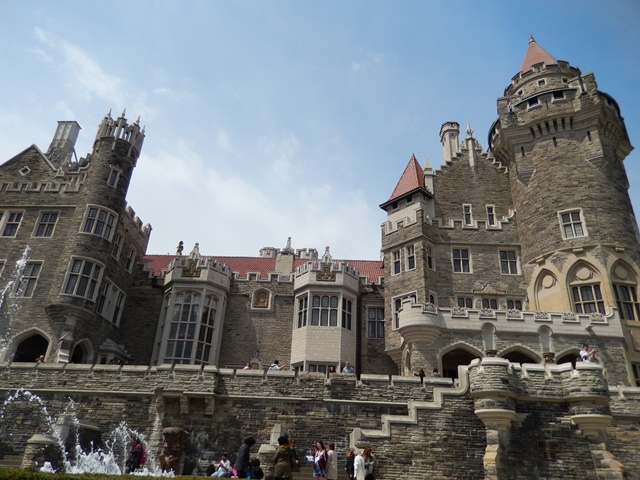
Built like a castle, it is a heritage structure that is more than a century old. Following Gothic-style architecture, it used be a villa owned by a prominent figure of those times, Sir Henry Mill Pellatt. Since we weren’t sure of who he was, we sat in on the documentary that was being screened in one of the rooms of the castle.

Sir Pellatt was a Canadian financier and soldier for The Queen’s Own Rifles of Canada. His most significant achievement was that he brought hydro-electricity to Toronto. He commissioned architect, E. J. Lennox, who is known to have designed 70 buildings in Toronto, including the City Hall, to construct this huge mansion.

Queens

Sir Pellatt liked to throw lavish parties and entertain guests in style and looking at the palatial nature of the rooms, I wished I could have attended one of those parties. I was reminded of the book, The Great Gatsby, written around the same time, by F. Scott Fitzgerald where the author portrays the extravagant and flashy life of the rich and the famous in that era.

Room

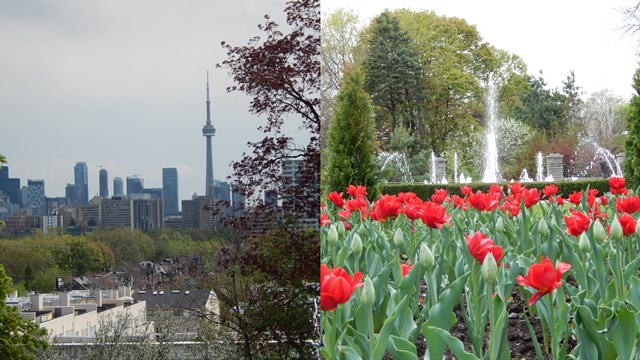
Casa Loma was built in three years, between 1911 and 1914, by 300 workers and incurred a total cost of 3.5 million dollars. It was strategically located, on a hill, to gain a complete aerial view of downtown Toronto. Surrounding the castle are well-tended gardens spanning five acres and fountains that make for interesting photo ops. I read that the Casa Loma gardens won the Phoenix award from the Society of American Travel Writers.

Garden

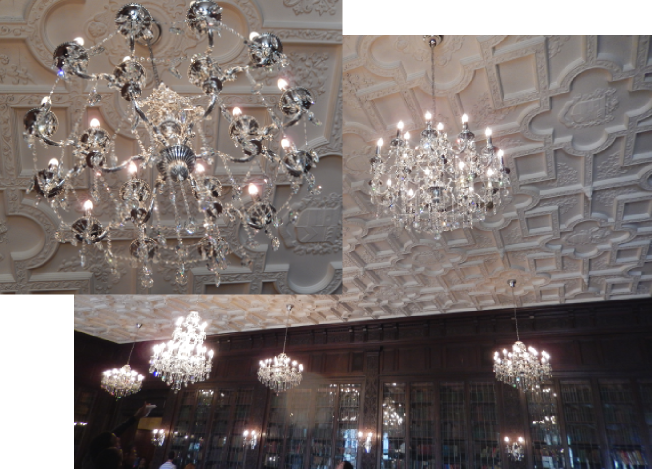
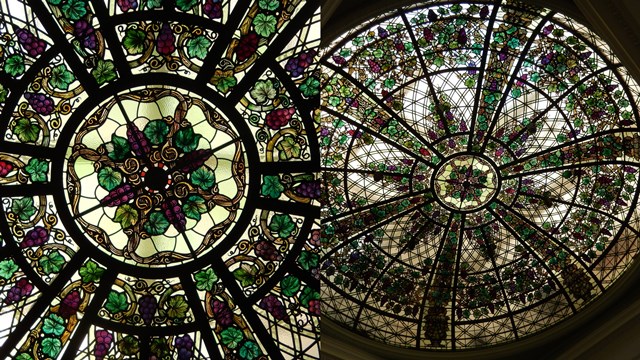
My favorite room, in the castle, is the library with its crystal chandeliers and the continuous array of wooden bookshelves lined up floor-to-ceiling, covering an entire wall. The conservatory has a mesmerizing glass dome roof adorned by stained glass paintings; so were the windows that spread across the room, making it the best-lit room in the house.

ceiling-chendelier

Roof

The exciting part came up when we took a walk along a long winding dark underground tunnel that led us to the garage and the horse stable. The stable, once upon a time, was home to six gorgeous stallions. Each stall had the name of the horse carved in it and looked royal. The garage displayed refurbished vintage cars, which seemed fabulous to wheelcrazy me.

Tunnel

antique-cars

Some of the rooms, on the upper floors, are converted into war museums in order to treasure the artifacts from World War I and II.

Artifact

We saw some interesting signs along certain articles like the below.

Photo 5-18-2014, 15 45 52

These days, the library and the conservatory are used as wedding venues. In fact, just as we were leaving, we saw the staff getting the place ready for such a function and for a fleeting moment, we thought of lingering back and crashing the party!

27 May 2014

The Museum Across the Bridge

This Sunday I knew I was going to Brooklyn… interesting things happening there. The Botanical Garden is celebrating Sakura Matsui (Cherry Blossom Festival) with traditional Japanese taiko drumming and martial arts, Japanese classical dances, an all-female marching band, anime rock from Tokyo and a samurai sword play… while the Brooklyn Museum is showing a number of very interesting artists including Ai WeiWei from China. The decision was made for me when the day dawned all chilly and windy… definitely a day to stay indoors. So the museum it was.

museum

Brooklyn Museum is New York City’s second largest museum and has an extensive collection of antiquities from all over the world. The Egyptian, African, Oceanic, and South East Asian collections are so large that only a part of them can be displayed at any time. That too, with an area of 560,000 square feet!
In addition to the historical artefacts in the various galleries, the museum also displays works of contemporary artists. Currently on view are controversial Chinese artist Ai Weiwei, artist and author Judy Chicago and street artist Swoon. Other prominent exhibitions currently on are Witness: Art and Civil Rights in the Sixties, and Connecting Cultures. Fortunately, the museum allows photography in most of the areas, sans the flash of course. So that was a delightful Sunday indeed!

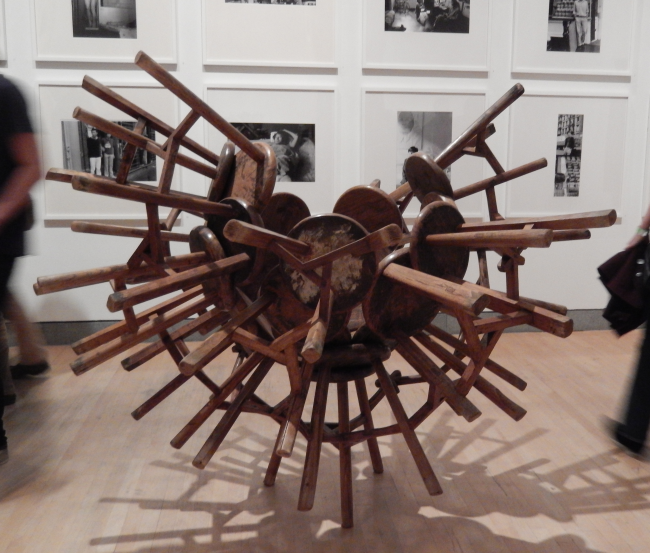
chairs-aiweiwei

When looking at Ai Weiweiis art, the first thing that impressed me is the creative ways in which he has used art as an expression of his activism. The person speaking loudest from behind each of the exhibits at the show is the activist, not the artist. And that is essentially the power of his art.

crabs-aiweiwei

Just take a look at this… six iron boxes the size of small rooms. You can step on a stool and look inside through a small square of glass. What you see inside is Weiwei while he was imprisoned by the Chinese government in 2011. These dioramas named ‘S.A.C.R.E.D’ show him sleeping, eating, showering, undergoing interrogation and sitting on the toilet, all under the watchful eyes of guards.

diorama

A strong criticism of the Chinese government’s handling of the 2008 earthquake in Sichuan is presented in the exhibit ‘Straight’ which displays tons of long reinforced steel bars from the Sichuan earthquake sites, straightened and laid out on the floor like rippling water. Another piece of art ‘Snake Ceiling’ shows a giant snake made up of children’s backpacks to commemorate the thousands of children who died in the earthquake.

ceilin-snake-aiweiwei
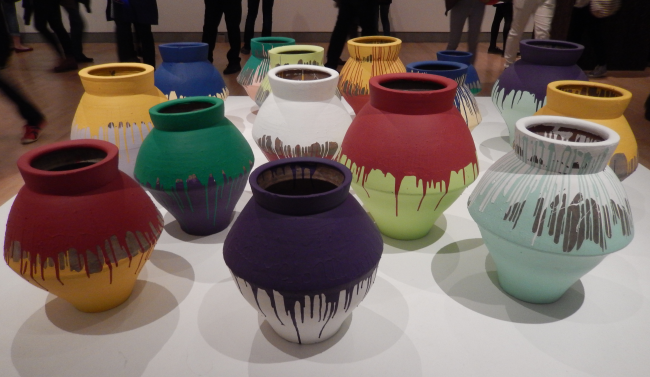
Seeing the crowd around his ‘painted vases’, I couldn’t help wondering about the value of political art as opposed to art for art’s sake. Especially in the context of the Dropping the Urn stunt and the follow-on act at Miami with a million dollar Ai Weiwei vase. 🙂

pots-aiweiwei
 
swoon-tree


Swoon has made a name for herself as a street artist. And her show ‘Submerged Motherland’ is an installation consisting of a huge tree, made of pieces of cloth and old canal boats people lived on. The tree with white paper leaves in the typical swoon style, is a pretty sight. Though it is doubtful whether the artist would appreciate the adjective ‘pretty’!


Once an editor, always an editor; is that true? Anyway, I was walking through the Judy Chicago show and caught a typo – ‘she changed her same’ instead of ‘she changed her name’! Unfortunately, that was one part of the show where photography was prohibited. Anyways, I made a point of going to the Information counter and reporting the typo. Good deed for the day, done!

brooklyn-bridge-georgia-okeefe

And any talk about this visit to the Brooklyn Museum will not be complete without this beautiful painting by Georgia O’Keefe… and not a single flower in sight! What a joy!

 ~Ria

02 May 2014