Tag Archives: New York

The Park in the Sky

How often does one get a chance to be part of history? That too, the history of such magnificent city as New York? Such was the good fortune of the people around when the Highline opened on June 9, 2009.

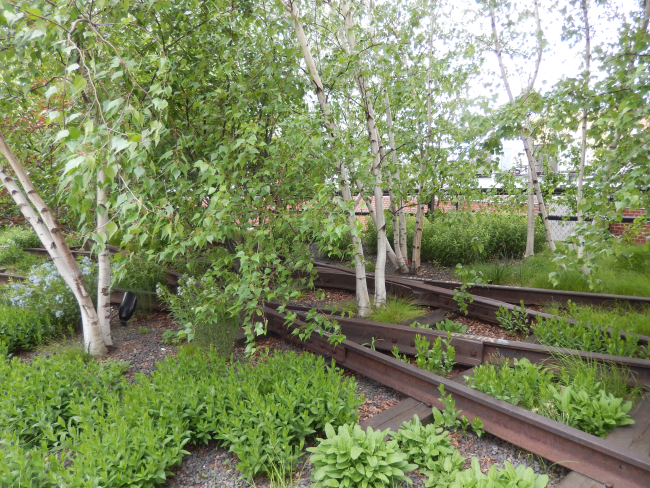
What is Highline? It is a beautiful, beautiful park that was built and nurtured on the abandoned old tracks of the 6th Avenue El!

hl-rails2

A bit of flashback… the Els, or elevated railroads, in New York were built to avoid the frequent accidents that used to happen with the freight trains running on the ground in the city. It was sooo bad that horse-riding men were employed to gallop ahead of running trains, waving red flags, to keep pedestrians off the tracks! Hence was conceived the idea of train tracks off the ground and running above the city streets.

On June 5, 1878, the 6th Ave El started operations. It covered a distance of 13 miles with stations at Rector St, Cortlandt St, and Park Place on Church Street; Chambers St, Franklin St, Grand St, Bleecker St on West Broadway; 8th, 14th, 23rd, 28th, 33rd, 42nd, 50th and 58th Streets on Sixth Avenue. The line also connected directly to factories and warehouses, enabling freight trains to deliver meat and produce – raw as well as processed – inside the buildings. And what is great, is that the traffic on the El did not affect the ground traffic at all!

However, by the 1930s, the decline of the El had started. The entire structure had weakened beyond hope of repairs. After being operational for 60 years, it was decided that the 6th Avenue El will be torn down. And on Dec 4, 1938, the operations on the line came to an end. And parts of the line were dismantled.

Fast forward to 1980s… plans are being made for the demolition of the remaining parts of the El. Local residents headed by environmentalists and activists challenge the plans in court. In 1999, a neighbourhood group, ‘Friends of the High line’ is formed to find alternate usage for the space offered by the now defunct railroad tracks.
Gradually support for the group increases and in 2002 a City Council resolution is passed advocating the reuse of the tracks.

In 2004, funding from the city is acquired for the development of the tracks. A design is selected through competition and the Highline Park comes into being, with the first section extending from Gansevoort Street to West 20th Street open to the public on June 9, 2009!
hl-rails1

‘Enchanting’ is an apt word to describe the Highline. The rail tracks are kept intact and flowers, shrubs and trees of all kinds are planted along the sides and between the tracks. And they change according to the seasons, adding variety to the overall sense of greenness that the park has.

hl-flowers

The rail tracks that used to go into the meat packing factories and other manufacturing facilities can still be seen, though the entrances to the buildings are blocked up.

hl-rails4

You can enjoy coffee, snacks and ice cream in one of these red brick factories, converted to a small marketplace. Also, you will find commemorative t-shirts, pens and very interesting books in the marketplace.

hl-rails3

And the Highline has become a venue for art shows and exhibitions. The other day when we visited, a sculpture show was going on, attracting quite a few fans.

hl-artwork

In fact, the whole area surrounding the Highline has developed an aura of artiness as evident from the street paintings and art objects.

hl-neighbouring-art1

Looks like even the neighbouring buildings are inspired to contribute to the effort!

hl-neighbouring-art2

And the views! Boy oh boy! It’s wonderful to look along the streets from the height of the Highline Park.

hl-view-left

And some of the best views of the Hudson are from the Highline.

hl-hudsonview2

Looking for an exotic venue for your next event or occasion? Come to the Highline! And if you are in a mood to help out with the park, you can always volunteer. All in all, the Highline Park is making history in the neighbourhood!


~Ria

06 Jun 2014
Broadway!

If anyone was asked to name the most heard of street – road, highway, boulevard, whatever – in the world, the universal answer will be ‘Broadway’! Reaching far back into history, and glorified in so many works of fiction and poetry, this thoroughfare could be the most identifiable single element of the great city of New York!
 
broadway

This is the oldest north-south arterial road in New York, existing from pre-Dutch times, when it was just a trail used by the native Americans. With the Dutch settling at the southern end of Manhattan island in 1620s, it became a country road extending north, beyond the gates of the settlement at present-day Wall Street. Today Broadway runs the length of Manhattan, starting at Bowling Greens in the south and moving out of Manhattan past 220th Street. (Actually, it extends further another 20 miles, to end at Sleeping Hollow in Westchester county, but it’s the Manhattan part that matters, right?)
 
happy-bus
Broadway could not be contained within the grid system of New York City roads, adopted in 1811, and goes diagonally for most of its way through midtown. That also explains the curious shapes of some of the buildings at Broadway’s intersections. A prime example of this will the Flatiron Building.
 
parade1

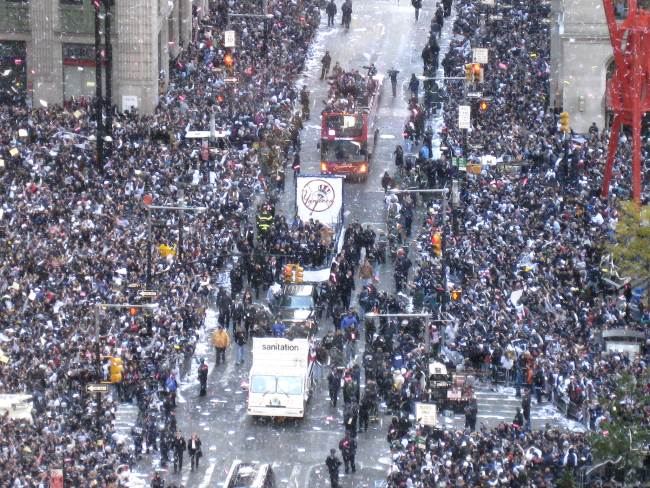
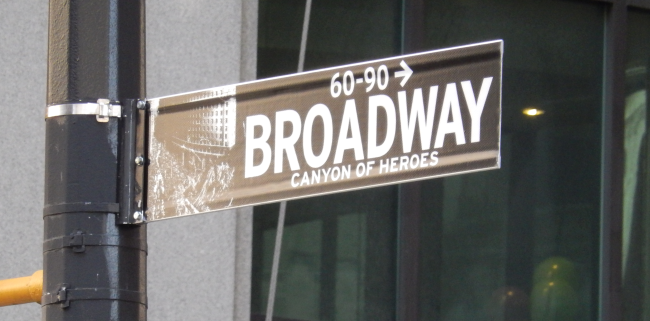
Starting with an impromptu parade on October 28, 1886 to celebrate the dedication of the Statue of Liberty, Broadway has always been the place for parades. A parade could be to honour a visiting head of state or someone with a major achievement, or to celebrate a victory in a sports event or anything else significant. Thus did Broadway get the sobriquet ‘Canyon of Heroes’.
 
parade2

The new generation may not – will not – remember the quarter inch ticker tapes that carried the stock prices from the exchanges and spewed out by the stock ticker machine. As the lower part of Broadway has always been lined on either side by financial institutions and brokerage firms, they had a lot of this ticker tape lying around. So what was more natural than showering some of it on the procession going down on Broadway… yep, just like confetti! And thus did the parades on Broadway get the name ticker tape parades.
 
parade3

These days, the ticker tape parades go from Battery Park to the City Hall. And each parade is commemorated by a granite strip with the name of the person being honoured set into the sidewalk of the Canyon of Heroes.
 
amelia-two

Only, instead of the ticker tape, paper from the shredder is most often used!
 
nehru
Along the Broadway are Wall Street, Zuccotti Park of Occupy Wall Street fame, Trinity Church, City Hall Park, Union Square, Times Square, Columbus Circle and Central Park, Columbia University, The Cloisters, and a host of other interesting places.
 

trinity

Trinity Church

And these days Broadway has become a synonym for theatre in NYC! Mainly for the reason that the theatre district where the majority of the playhouses are located, is right on the Broadway. And from there, you have off-Broadway and off-off-Broadway performances as well! And if you want to snag some discount tickets, that can be done at the ticket kiosk at Times Square too!
 

tkts

Ticket booth at Times Square

zuccoti

Zuccotti Park

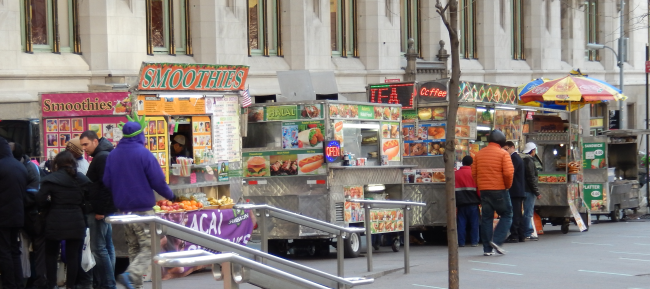
food

Food trucks along Broadway, downtown

A random thought… wouldn’t it be great to do a full walking trip of the Broadway, from one end of Manhattan to the other? Say for example, start at Broadway Bridge at the top of Manhattan and walk all the way to Bowling Green… sounds awesome! So here it is… before this summer is over, I’m going to do that. It takes me around 15 minutes to walk a mile; 13 miles in a day will be easy-peasy! One more item added to the summer fun!


~Ria

16 May 2014

Back to downtown for a lunch time walk…

Soon after I had moved to the mid-town office (The salt mine I work at has offices all over the world!), I had taken a happy break from winter, going to work from our Bangalore office. So it had been a while since I was in downtown New York. Okay, five months, but this is New York and a lot can happen in five months! And recently when I went to meet a few friends there, it was like a new place… all exciting and interesting! And of course, I went on a lunch time walk. So this is for all my friends who used to share that walk in times gone by…
 
path-tunnel

The first noticeable change was the new connection to the Winter Garden from the World Trade Center PATH station. Gone is the bridge and corridor overlooking the construction site at WTC. The high ceilinged concourse is stunning, with the pillars arching over, way above the pedestrians. Designed by Santiago Calatrava, the concourse is part of the transportation center at the WTC, scheduled to open in 2015. The concourse will have shops lining the sides when whole construction is complete.
 
winter-garden

The Winter Garden is also being redone, of course, without changing the iconic basic structure.
 
trees-winter-garden

The trees outside the winter garden always reminded me of candelabras in their winter state. And in the next week or so, those branches will be adorned with green leaf clusters, obscuring the structure of the branches, but providing such delightful shade to people taking their lunch break under them.
 
tree-with-buds

The trees have already started sprouting buds, even as last year’s dry seeds are still hanging on.
Squirrels are already busy starting their collection for the next winter. Come on buddies, don’t worry… winter is sooo far away!
 
squirrel1

It is a wonderful walk along the tree lined walkway to the battery Park, with river Hudson on one side.
 
battery-walk2

I love the blue lights along the South Cove where one can climb up on the viewing towers to get a good look at the Hudson traffic and the Statue of Liberty.
 
blue-lights

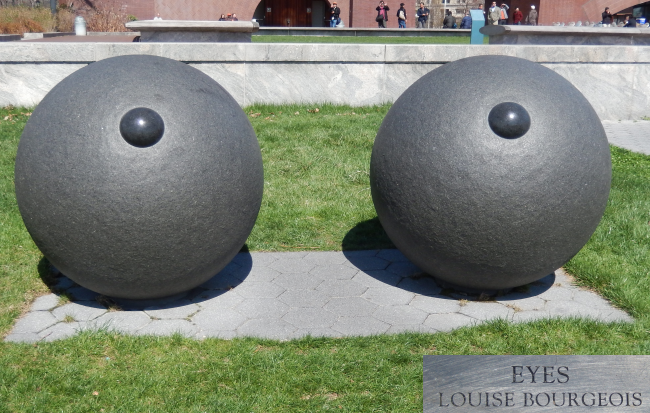
And there are interesting art works as you continue past the South Cove. One of the art works always aroused speculation among us though its name was clearly written. I have seen people looking at it from all angles to see what the artist wanted them to see, instead of what a first look told them. Here is the artwork for you…
 
eyes

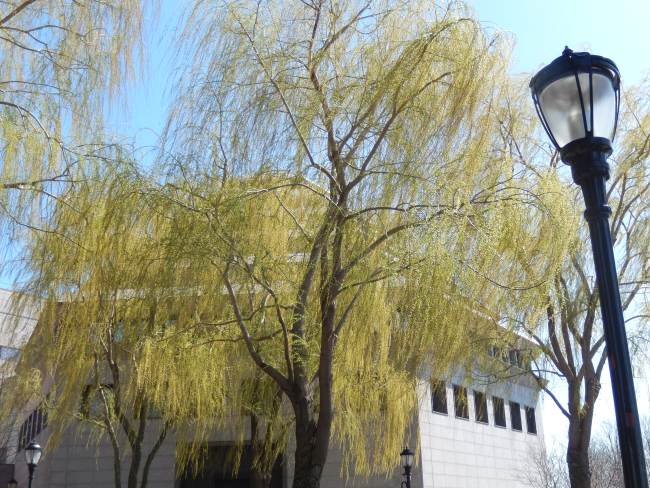
There is one willow tree that I take note every year; it is one of the first to sprout and it is ever beautiful with its delicate tresses waving in the breeze from the river.
 
weeping-willow

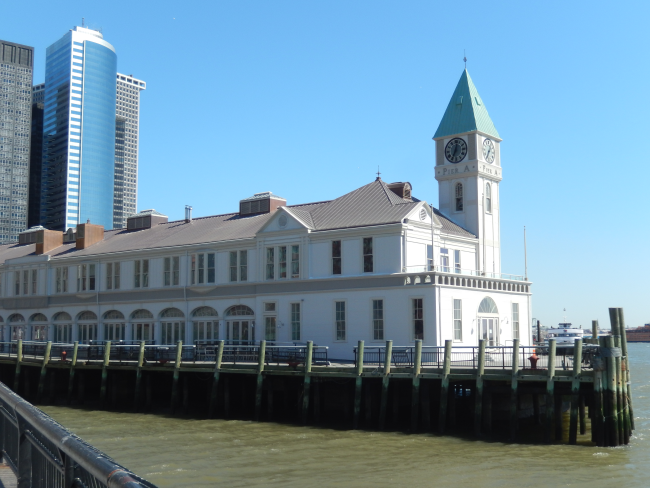
At the corner of Battery Park is Pier A, originally constructed in 1886 and in use variously by the New York City Department of Docks and Harbor Police till 1992. It is the oldest historic pier in the city and is a designated New York City Landmark. Currently, it is being restored and will be home to an oyster bar and restaurant.
 
pier-A

Charming is the apt word to describe the Manhattan skyline from this point. The red stones of the old buildings and the blue reflection on the new 1 World Trade Center tower look so well matched.
 
skyline-with-tower

From the Battery Park, I turn to Broadway and the walk back. Of course, saying Hi to the Wall Street bull.
 
wall-street-bull

The history of that bull and how it came to be in that spot is a story connected to the illustrious past of this financial capital of the world. Another time…
 

~Ria

09 May 2014

What is in a name? Seriously?

I am a great fan of AWAD (A.Word.A.Day), a daily subscription email list founded by Anu Garg of wordsmith.org. There are certain words that I might not have ever encountered but for the daily AWAD email. Petrichor jumps to mind… that lovely indescribable scent that emanates from the parched earth after the first rains, finally got a name when it dropped into my inbox one fine morning. Bringing with it, memories of monsoons and school reopenings which for some inexplicable reason coincided most of the time. But I digress…

place-names-word-cloud2

Last week’s AWAD theme was toponyms – words derived from the names of places. Got me thinking about how place names came into being. Also, about interesting place names.

It is easy to imagine the need to identify geographical locations in communications, even in cave people days. ‘Big mammoth felled at rock mountain; come, join the fun’ would prevent a lot of that mammoth going waste, you can imagine. 🙂 And most of the earliest place names were based on geographical features, naturally. That trend continues to the present day with innumerable names like Glendale, Riverside, Hillview, etc.

A lot of place names were carried over from the old countries by immigrants who were nostalgic for the lands left behind. New York (earlier, New Amsterdam, when it was owned by the Dutch), Lancaster, Brunswick (New, North, South), Rochester, Stamford, Berlin, Copenhagen… they are all present. When I was travelling in Egypt, the tour guide asked us why we had to have a Cairo and Alexandria in the US. The only answer we could give was that the US is a true melting pot! 🙂

place-names-word-cloud1

Many of the current place names are derived from their original names used by the native Americans, which again were based on geographical features. A prime example is Manhattan, from ‘manna-hata’ meaning ‘island of many hills’ in the language of the Lenape tribe. Massachusetts (by the great hills), Connecticut (place of the long river), Hoboken (where pipes are traded), Passaic (river flowing through a valley)… very interesting to take a look into the thousands of such names.

Then there are place names that exist in every state, sometimes more than once in the same state. Middletown, Harrison, Bloomfield, Fairfield… can you think of any state that does not have towns with these names?

Then there are the truly interesting place names. Like Cut and Shoot in Texas, Casa Blanca and Moriarty in New Mexico, Hell in Michigan, Real and Loving also in Texas (two towns, not Real Loving!), Caliente (meaning ‘hot’ in Spanish) and Steamboat in Nevada… the list goes on. Not to forget Blue Ball and Intercourse in Pennsylvania, so inexplicably close together!

But my favourite is Truth or Consequences in New Mexico. According to my friend Google, the city called Hot Springs changed its name to Truth or Consequences, the title of a popular NBC radio program, in 1950, in response to a promise that the program will be aired from the first town that renamed itself after the show. Voila! Hot Springs got a new name!

The most poetic and literary place names I have come across belong to Columbia, Maryland. Columbia is a planned community with self-contained villages and its localities are named after places in the literary works of well-known American authors like Hemingway, Scott Fitzgerald, Walt Whitman, etc.place-names-word-cloud10

Kind Rain, Scarlet Petal, Rising Moon, Deep Calm, Open Sky, Tawney Bloom… can you imagine any more poetic place names?

Divider2-LR-4px

Interesting thought…

According to Wikipedia though the word Manhattan has been translated as ‘island of many hills’ from the Lenape language, the Encyclopedia of New York City offers other derivations, including from the Munsee dialect of Lenape: manahachtanienk (‘place of general inebriation’), manahatouh (‘place where timber is procured for bows and arrows’), or menatay (‘island’). Which one would you think is most apt? 🙂

Divider2-LR-4px

27 Jan 2014

NYBG Train Show

train-show-small

I was so afraid I was going to miss the NYBG holiday train show this year. For starters, I was travelling for almost the whole of December. And, once I got back, the polar vortex also arrived, bringing ice and snow and sleet with it… Still, despite all odds, I made it in the nick of time… went and saw it on the last day of the show! 🙂

As my people already know, I am a great fan of trains. Small trains, big trains, unusual trains… all of them. Even the PATH trains. But at the NYBG show, I found the trains sort of meh… What really got me was the landscaping.

Combining historical and geographical interest, the show features 140 iconic New York buildings, many of them from dates past. The models are made to scale using all natural plant parts. It is almost like a miniature tour of the city!

This year’s show features 21 model trains and covers 6,000 square feet of area with 1,200 feet of track laid out. The trains in the show are G-gauge and represent American trains from the late 1800 steam engines to today’s high speed passenger trains.

A new introduction this year are trains made of plant parts, looking like they are straight out of some fairy tale. Hoping there will be many more of them next year!

train-show1

Among the buildings recreated are the Brooklyn Bridge, the New York Public Library, the Guggenheim, City Hall, St. Patrick’s Cathedral, Radio City Music Hall, Rockefeller Center, the original Pennsylvania Station, Met Museum and many many more.

The train show debuted at the NYBG in 1992. The designer behind the wonderful miniature landscapes is Paul Busse, assisted by a team of 20+ artists and engineers of the Applied Imagination team. More examples of their fascinating work can be seen at www.appliedimagination.biz.

train-show2

Plans for the buildings are made with the help of photographs and architectural drawings. Then a shell is made with foam board. Twigs, bark, moss, leaves, flowers, acorns, pine cones, seed pods… anything that comes from nature is used to mimic the architecture. The finished product is coated with a thin layer of resin to protect it from dust and moisture.

train-show3

Each structure involves hundreds of hours of painstaking work, with every intricate detail recreated through the imaginative use of materials. The minute details, executed so meticulously, truly gives meaning to that oft repeated word ‘awesome’!

details

I was left with the definite impression that the original structure would have been way better if it was constructed with natural plant parts! 🙂

Notice the pistachio shells and corn husk?

Notice the pistachio shells and corn husk?

The holiday train show is held at the Enid A. Haupt Conservatory of the New York Botanical Garden.

~Ria

Divider2-LR-4px

From the ‘Am I seeing things?’ department

Was Sunnyside, Washington Irving’s home in Tarrytown, featured twice in the show? I believe so (in fact, I have documentary evidence!) but realised that only when I was looking through the pictures taken! 🙂

Divider2-LR-4px


15 Jan 2014