Author Archives: Ria

Boston – the City of Firsts

The first public park, the first public secondary school, the first public library, the first State Constitution, the first regularly issued American newspaper… the first windmill, the first chocolate factory, and the first pub in the country… it will take a while to list all the firsts that belong to Boston.
 
The first public anti-smoking law (that too, in 1632!) was passed in Boston… the first woman in the United States to earn a Ph.D. did so from the Boston University… the list seems unending.
 
Founded in 1630 by a group of Puritans, Boston is one of the oldest cities of the United States. Puritans were English colonists who arrived in the 16th and 17th centuries in America, dissatisfied with the church of England over the church’s tolerance of practices aligned with the catholic tradition. Boston played a key role in the American Revolution, being the scene of events like the Boston Massacre and the Boston Tea Party.
 
In addition to being an important port and center of trade and manufacturing, Boston is well known for its educational and cultural institutions. Above all it is an architecturally beautiful city. So when I got a chance to do a quick trip to Boston one of these recent weekends, I jumped at the chance.
 
The first place we stopped at was the Harvard University campus. Did I tell you that it is the country’s first college? The spacious campus with brown stone buildings impart a sense of peace and calm.
 
BCF-campus

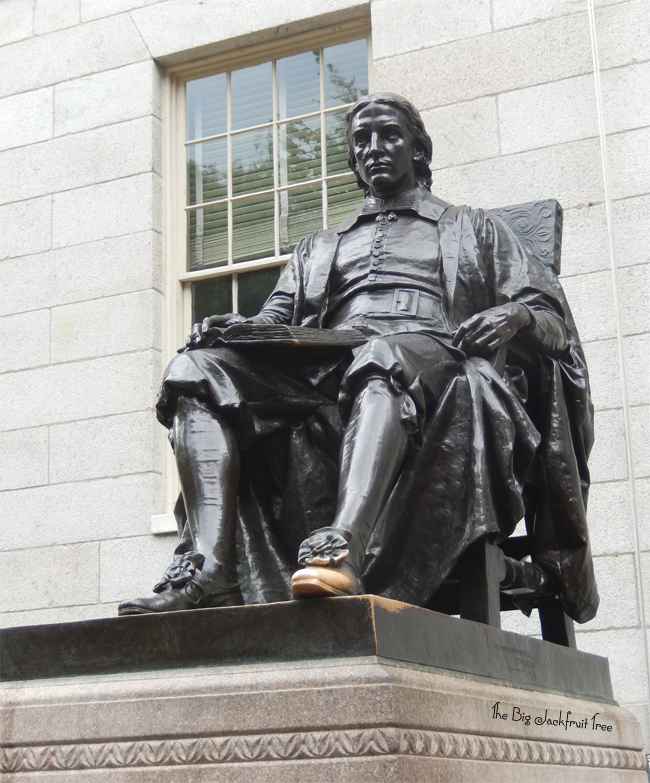
The statue of John Harvard on the campus gets constant attention from visitors, particularly young ones. They are posing one after the other for photos with the statue that it is hard to get a click in without someone clinging to the statue’s foot.
 
BCF-john-harvard

Did you notice how shiny it is? It is believed that touching the statue’s foot brings good luck. And what happens there at night? Read for yourself here.
 
BCF-statue-plaque

By the way, this statue is commonly called, ‘The Statue of Three Lies’, in the sense that contrary to what is said on the base of the statue, it is not John Harvard, John Harvard is not the founder of Harvard University, and Harvard University was not founded in 1638. Read all about it in the Harvard Summer Blog.
 
BCF-library

That day, the weather had some harsh treatment in store for us… it rained for the better part of the day! Despite the rain, we managed to visit some real interesting places.
 
BCF-park3

Established in 1837, the garden has an area of 24 acres, with beautiful paths and formal flower beds. The lake in the garden apparently, always have two resident swans.
 
BCF-park2

A 15 minute ride on the swan boats – a special attraction of Boston – takes you around the 4-acre lake in the garden for an utterly peaceful time with picturesque views.
 
BCF-park

Though we wanted to, we did not have sufficient time to visit all the stops on the Freedom Trail, a 2.5-mile, brick-lined route that leads through 16 historically significant sites associated with the American revolution.
 
BCF-freedom-trail

The whole trail is marked by a red and gray brick path.
 
Any visit to Boston will not be complete without a look at the Boston Harbour, the scene of the Boston tea party, an event on December 16, 1773 where a group of patriots boarded a ship of the East India Company and threw chests of tea into the harbour, in protest against the Tea Act of May 1773. They were protesting – contrary to what many people understand today – not against taxation, but taxation without representation as the American colonies did not have a representative in the British parliament.
 
BCF-harbour

The dark look of the sky that day somehow suited the memories of that historical day.
 
Boston has so many firsts to its credit, but I want to give it a ‘best’ on my personal account. The best clam chowder – ever! It was so great I have decided to look on my bookshelves for my historic Boston cookbook, handwritten no less, to find a traditional recipe to follow.
 
BCF-clam-chowder

And do you know who this is? Yes, Sam Adams, exactly like he is on the bottle! 🙂
 
BCF-sam-adams

Boston has so many things to boast of, if it wanted to, but it will never do so because then it will have to change its spelling to ‘Boaston’! Yep, that deserves all the groans that it will garner, but couldn’t help it! 😉
 
And much to the chagrin of Bostonians, Forbes magazine rated Boston as the 9th ‘Coolest City’ in the country! Yeah, it’s hard when you are accustomed to being first and then have to put up with being 9th!


~Ria


08 Aug 2014

Trains… A Joy Forever!

There are some things in every one’s life that have a lasting charm… some threads that run through life, helping keep alight the joy of life even when things are not so good. Something that gets you excited about life itself. For me, it is trains. I love trains… I mean, all trains. Long distance trains, commuter trains, touristy trains… love them all. And never give up a chance to ride on one either.
 
I don’t know when I was bitten by the train bug. In fact, I cannot remember a time when I was not enchanted by the trains. When I was in third grade, we were doing a chapter on transportation. Teacher asked whether there was anyone in the class who had not travelled on a train. To my utter amazement, a number of hands went up. And I was thinking… where have you been living? Under some moss covered rocks? Lived thus far without a single train ride? The pity I felt for those kids was fathomless. Even at that age, a train ride was one of my favourite things.
 
As I grew up, I found out that there are kindred spirits all around the world. Known by various names such as railfans, rail buffs and train buffs, they form groups and go train spotting. Yes, it is a legitimate hobby, with many followers. Train photography, model trains, exploring historical railway tracks and trains, and collecting train memorabilia are some of the activities of these groups.
 
You have to admit… some of the old trains are a pleasure to see. And you never get bored watching a train go by. Whenever a car I’m travelling is stopped at a railway crossing, and there are groans from the rest of the party, I’m secretly thrilled though I have to hide my glee! 🙂
 
As fun it is to watch a train from the outside, it is equally interesting to watch it from the inside. I mean watching the people. Where else would you get such a golden opportunity to watch a microcosm of society, yourself unobserved? Some of the people are busy reading the newspaper or books, some are engrossed in prayers and rosaries, some keep yakking away to either their friends or on the phone… some even do their chores like opening the mail or doing their nails.
 
One thing interesting about New York trains – including the subways – is that you get to hear all kinds of languages. Sometimes when a conversation in a language I do not understand gets too loud for comfort, I have a trick to bring it under control. I pretend to be seriously listening and smiling or frowning at all the right moments. And the conversationalists begin to wonder… does this woman understand what we are talking? In no time, it is toned down and there is peace and quiet again.
 
Let me ask you a question. Imagine this scene… you get on a train, from a station in between, and you have a ways to go. All the window seats are taken. Some of the people have their bags and papers all spread around on the aisle seats and are sitting taking up most of the two seats. Others have kept their possessions neatly on their laps and the aisle seats are left free of any encroachments. Where would you opt to sit? Don’t you think that by that choice, you are rewarding bad behaviour? 😉
 
Whenever I go visiting a new place, I would find out if there are any interesting train rides around. Very often, there are. And I never let go a chance to ride on one of them. This is a train from St. Kitts, that went around the island and the old sugar cane farms, keeping the Caribbean always within sight on one side. It was wonderful!
 
st-kitts-train1
 
One of the activities of the railfans is called ‘complete riding’, which is to try and ride the complete railway network of a city, state, or country. It would be an interesting activity to consider during the fall in NYC.
 
I cannot end this note without a shoutout to a fellow railfan… you all have seen him, laughed with him and at him. And said ‘Bazinga’ with him! Yes, I mean Sheldon Cooper from ‘The Big Bang Theory’ whose love for trains is as intense as mine!
 
And the only reason I do not have an elaborate train set running on the floor of my apartment is that I live in a matchbox!
 

~Ria

01 Aug 2014

The Joys of Storytelling

The crickets in the bushes have started their chirping, though the last red glow of the setting sun is still lingering in the western sky. Dinner is already over, and the womenfolk are in a hurry cleaning up. The children, impatient as ever, have already ran off towards the village center, not waiting for mother or grandmother. Groups emerge from the houses along the street and move off, excited voices filling the air. The torches lighting their path in the swiftly darkening night all appear to be converging on one point… the village center. This is one night nobody wants to be away from there… yes, the story teller is visiting the village!

 
This is a scene repeated a million times over in a million villages around the world. The languages will be different, the stories will be different, the people listening will be different… but the enchantment of stories is universal. Every one of the ancient cultures has a story telling tradition, where good fairies and bad witches and folk heroes and sweet damsels all make appearances to charm an enthralled audience for hours together. Many of the classical dance and song forms actually follow the storytelling traditions.
 
As stories and storytelling largely moved over to printed books and later, to celluloid, the human interaction of the community storytelling is one of the sacrifices we made to the modern life. However, have you noticed the interesting new efforts to revive the storytelling traditions in the modern context?
 
Foremost among these is The Moth. Anyone listening to NPR even infrequently, will be familiar with The Moth Story Hour, where the stories from Moth stages are repeated on the radio. The Moth is a not-profit organisation dedicated to the art and craft of storytelling. Events are held at various parts of the country and abroad. Anyone can pitch a tale and selected stories are narrated in front of a live audience. People from various walks and stages of life participate in the event. The stories are as varied as the people who tell them, and of course they are very interesting.
 
Interesting in the sense that they will make you laugh, think, sympathise… even teach you something new, often all at the same time. I listen to them on the radio and have been thinking of attending one of The Moth StorySlams, an open-mic storytelling competition held in New York every week. One of these days… maybe even participate. 🙂
 
Another storytelling effort is StoryCorps, an oral history project, run by an independent non-profit organisation. Participants – there has to be two, as it is recorded as interviews – go to the StoryCorps booths and record the conversation. These conversations are preserved at the American Folklife Center at the Library of Congress. Since 2003, StoryCorps has recorded and archived 45,000 conversations. You can listen to a sampling of these conversations here.
 
Did you know that a National Storytelling Festival takes place in Jonesborough, Tennessee every year, during the first full weekend of October? It is conducted by the National Storytelling Network, dedicated to advancing the art of storytelling. It is a three day outdoor festival, with storytellers from all over the world participating and an estimated audience of over 10,000.
 
The National Storytelling Network conducts events all over the country, showcasing storytelling. Here is a calendar of events, in case you want to check them out.
 
Happy storytelling/ listening!

~Ria

29 Jul 2014

Gettysburg – A Journey into History

When we set out on a visit to Gettysburg National Battlefield, on a sunny day in early spring, I was counting on a glimpse into an eventful chapter of history… but the extent of it was an eye opener and way beyond my expectations.

The battle of Gettysburg was one of the biggest battles in the Civil War, fought between the Confederate and Union armies – the Army of Northern Virginia led by Confederate General Robert E. Lee and the Army of the Potomac led by Union Major General George Meade.

This battle accounts for the highest number causalities in terms of people killed and wounded, and is considered the turning point when the tide started turning against the confederates. It was fought in and around the town of Gettysburg (obviously!) over July 1 to 3, 1863. Over the three days, wins in the battle shifted between the sides, but by the end of the third day, a decisive blow had been struck and General Lee’s Confederate Army was forced to retreat, abandoning all hopes of a victory in the north. Intermingled among the stories of valour and heroism and utmost sacrifice in the course of the battle, are the stories of brother fighting against brother, and friend turning against friend. Just imagine the emotional upheavals that rent the hearts of so many people!

GV-memorials

I was very very impressed with the way the battlefield is maintained and managed. All the sites and monuments are clearly marked and the auto tour is the most helpful facility. You stop your car at the clearly marked auto tour stops and put the CD in the car’s player. The commentary provides you all the information to understand what happened at that site and its relevance to the battle and the war overall.

GV-info-board

Markers along the way tell the stories of the events and memorials pay homage to individuals as well as fighting units. Most of the states that participated in the battle on either side have also dedicated memorials.

GV-virginia-memorial

Among the state memorials, the earliest established was the Virginia Memorial dedicated on 6 June, 1917. It portrays General Lee riding his horse, Traveller. At the base of the are shown various men who left their civil occupations to join the war… a professional man, a mechanic, an artist, a boy, a businessman, a farmer and a youth.

GV-pennsylvania-memorial

The biggest of the memorials belong to Pennsylvania, dedicated in 1910. On top of the dome of the monument is depicted the Goddess of Peace and Victory. Above the huge arches are carved battle scenes honouring the four branches of the army, infantry, cavalry, artillery and signal corps. At the base, bronze tablets list the names of the 34,500 Pennsylvania soldiers who participated in the battle of Gettysburg.

GV-new-york-memorial

New York Memorial very impressive. Topped with an eagle and showing the state emblem, it displays the names of all commanding officers and their units, not memorialised individually.

GV-north-carolina-memorial

The North Carolina Memorial was one of the early ones, being dedicated in 1929. A wounded officer is shown urging his men forward, while he points to the enemy.

GV-mississippi-memorial

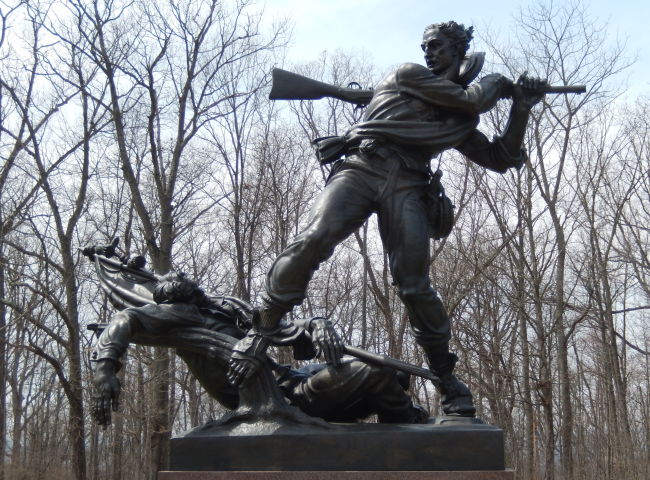
The Mississippi Memorial showing two infantrymen, one mortally wounded and fallen down holding the unit colours, while the other is in the act of defending the colours using his musket as a club, was dedicated in 1973.

GV-louisiana-memorial

The Louisiana Memorial depicts the Spirit of Confederacy holding aloft a flaming cannonball, rising over a fallen soldier – an artilleryman – who grasps a battle flag to his chest. This memorial was dedicated in 1971.

GV-maryland-memorial

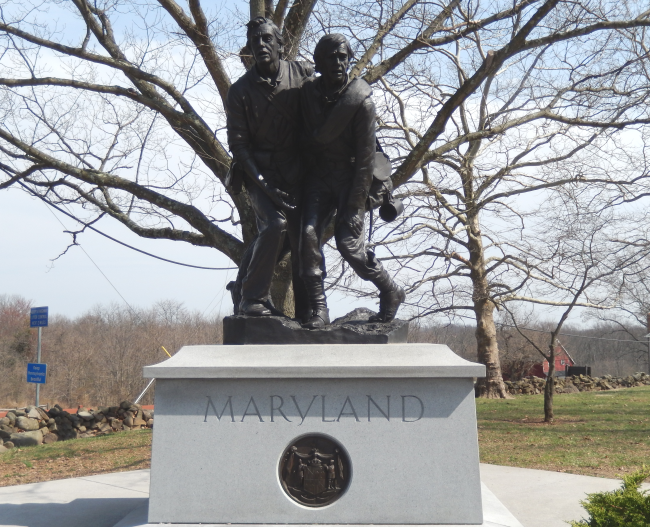
I like the Maryland Memorial very much for its conceptual inclusiveness. It shows two soldiers from Maryland, belonging to the two sides, helping each other. Also, a bronze tablet at the base lists the Maryland commands in both armies. This memorial was dedicated on 13 November, 1994.

GV-confederate-memorial

You will also find a memorial to the soldiers and sailors of the Confederacy, dedicated in 1965, to honour all the men who fought in Confederate armies and navies. It shows a colour bearer urging his fellow soldiers to come forward. On the base are inscribed the names of the states that formed the Confederacy.

GV-eternal-light

The 75th anniversary of the battle of Gettysburg was celebrated with around 2,000 veterans of the Civil War from either side attending. All veterans were invited to attend the function with expenses paid. At the gathering, on 3 July 1938, the Eternal Light Peace Memorial, a monument to peace and national unity, was dedicated by President Franklin Roosevelt. Made of Maine granite and Alabama limestone, the memorial is topped by an eternal light symbolizing the United States.

GV-markers

Markers like these are present all over the place and provide you the most valuable information to understand what passed here, so many years ago.

GV-canons

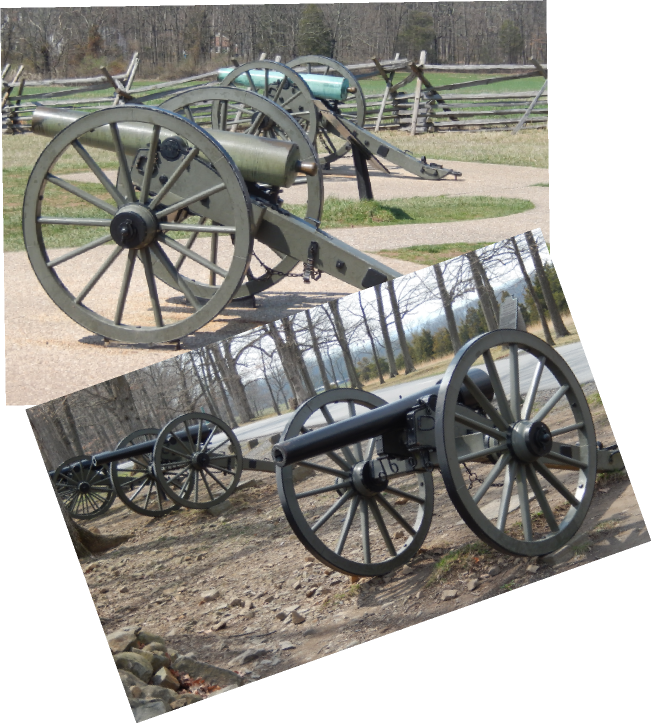
The different types of cannons used at the battle are on display at various locations at the site.

GV-cemetary

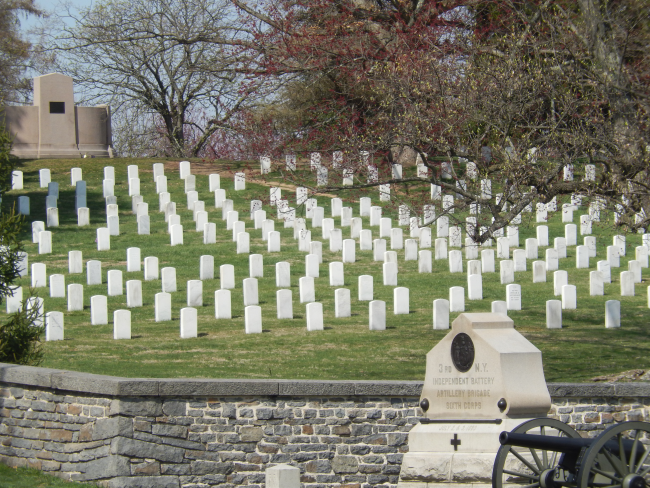
A view of the Gettysburg National Cemetery.

When you start talking about the Civil War and the Battle of Gettysburg in particular, there is so much to talk about… so many interesting snippets. How did General Lee’s estate and home in Arlington turn into the Arlington Cemeteries? What happened with the Schwartz brothers at the McLean House? Why did General Sickles often visit the National Museum of Health and Medicine? So much to talk about. Maybe another post, another day.


~Ria

25 Jul 2014

A Weekend in Stamford

Stamford, Connecticut… where the rich and famous live… so you must surely be one of them… that is how I used to tease my friend Archana (of The Perfect Zest), who lives there. Though I have visited her many times, never really found the time to explore the town. So when she invited me to spend a weekend at her place, with a promise to show me around, I jumped at the chance.
 
The town of Stamford was founded in the year 1641. Originally called Rippowam, after the local river, by the natives as well as the settlers, the name was later changed to Stamford – meaning stony ford – after a town in Lincolnshire, England. At that time, the settlement measured 128 square miles, though the area of Stamford at present has come down to 40 square miles.
 
In the early years, the town’s economy was based on agriculture, facilitated primarily by the New York City markets. After two centuries, the agri-economy slowly gave way as manufacturing picked up in the 1840s and Stamford became an industrial center. Today, Stamford is home to major corporations, financial institutions and capital market players.
 
Stam-chairs

Downtown Stamford is quite impressive, in a charming and bit quaint way. And colourful… especially with all those benches, part of an outdoor sculpture exhibition consisting of 40 originally designed and painted wooden benches. These benches are placed throughout Stamford downtown and at the Stamford Town Center.
 
Stam-bull

Also, on Bedford Street in downtown, you will see a replica of the famous Wall Street Bull, created by the same artist.

Stam-from-parking

The afternoon saw us heading to the Cove Island Park for a well deserved relaxing time, tired after a long lunch downtown. The park is right on the shore, with extensive walks and sandy beaches.
 
Stam-ocean4

Sitting under the trees on a bluff overlooking the Long Island Sound, with the breeze wafting softly over the water, New York city and its salt mines where I toil every day seemed far away!
 
Stam-ocean1

Cove Island Park offers several facilities like walking trails and cycling paths, we were too lazy to even consider any of those. Except walk a bit along the rocky shoreline, watching the avid fishers – human as well as birds – in action.
 
Stam-ocean3

If anything could get up out of the lethargy, it was the thought of the beer and burger picnic we had planned. What a wonderful evening indeed!
 
Stam-ocean2

Next morning, we went for a walk in the Mianus River Park… yes, I said that with a straight face. 🙂
 
Stam-trails

The park is located between Stamford and Greenwich, Connecticut, and has several trails of varying lengths and degrees of difficulty. At this season, everything is green, and so many shades of green too!
 
Stam-50-shades-green

50 Shades of Green!
 
The park extends to an area of 220 acres and consists of different terrains like low lying wetlands – with tiny brooks crossing the trails – and stony steep hillsides.
 
Stam-river-park1

It was pure pleasure walking the trails. One interesting feature of this park is the many rock outcroppings along the trails. Among the old growth trees reaching up to great heights, they really paint a fantastic picture.
 
Stam-rock-outcropping

Like all weekends do, this one too flew away like in a daze. And to think that summer is on the wane… still there is time, and a heap of things to do!


~Ria

22 Jul 2014